Note: This feature is available on all plans.
After a form goes live, the next job is not form creation anymore. It is response handling. You want to see who responded, narrow the list to the people that matter right now, inspect the details, and sometimes move those responses into a new status immediately. FORMLOVA lets that happen inside one conversation. In this guide, I will walk through a real example: listing response names, filtering by participant count, drilling into the matching responses, and updating both of them to In Progress.
Start by Asking for the Response Names Only
The first prompt in this example was:
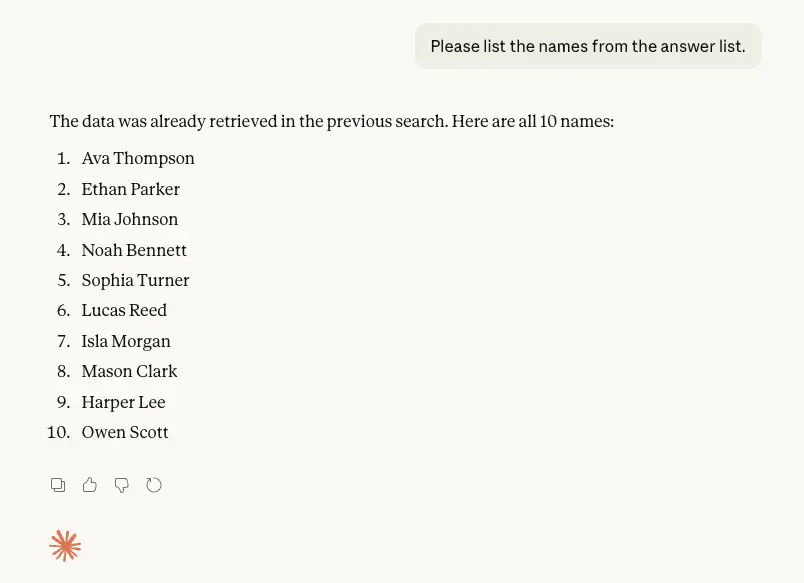
Show me the names from the response list.
FORMLOVA replied with a simple list of names from the already retrieved response data. In this case, it returned 12 names.
That is a good starting point. You do not always need the full payload of every response at once. In day-to-day operations, it is usually better to begin with a lightweight list, understand the shape of the data, and then drill down only where needed.
That is the first thing I want this guide to show. Response management in chat does not have to start with a heavy export or a dense dashboard view. It can start with a single sentence and a readable list.
Filtering Makes the Next Action Clear
Once the full list was visible, the next prompt was:
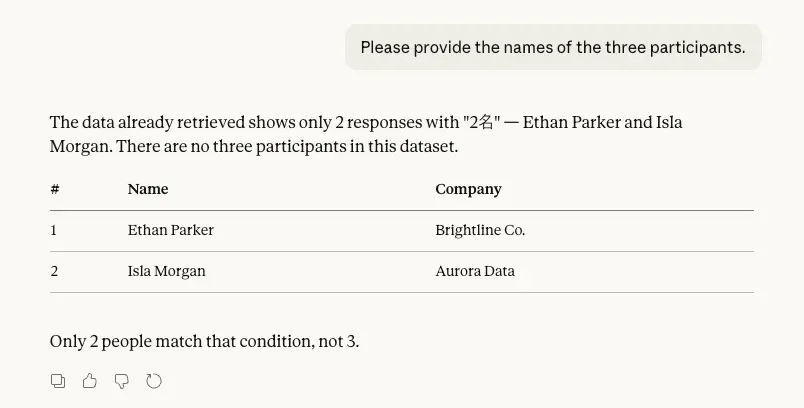
Show me the names of the people whose participant count is 3.
FORMLOVA answered from the already available data and narrowed the result to two people:
- Naoki Kobayashi
- Hanako Suzuki
This is where the workflow starts feeling operational rather than informational. In practice, you rarely want every response all the time. You want the subset that needs action now. In an event workflow, that might mean everyone who selected a certain attendance type. In an inquiry workflow, that might mean everyone asking about pricing. In a survey workflow, that might mean only low-scoring respondents.
That is why filtering matters more than the initial list. The list gives you the landscape. The filter tells you where to act next.
Once the Targets Are Found, You Can Ask for Full Details
After that, the next prompt was:
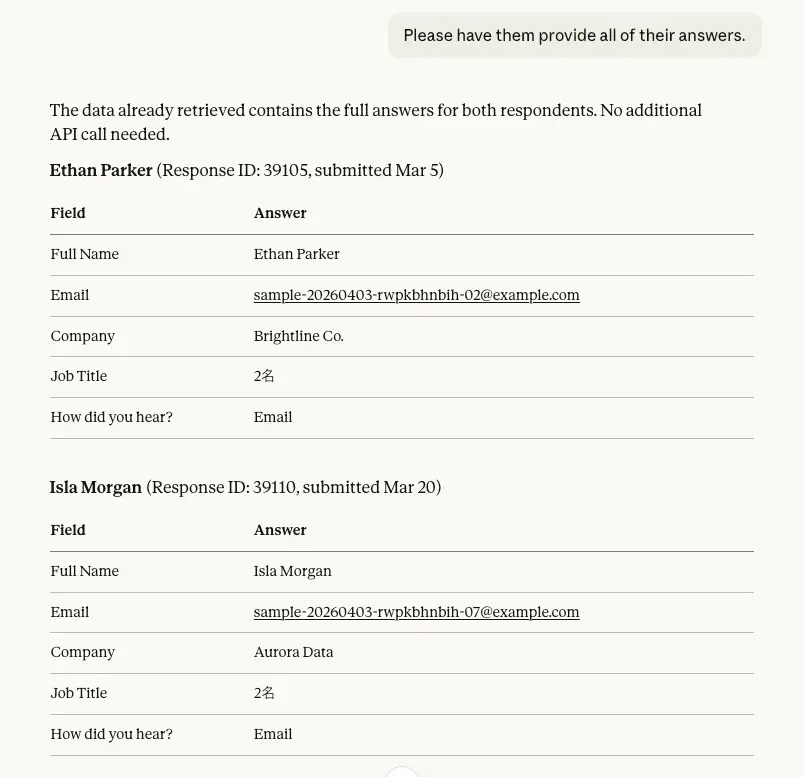
Please show all of their response details.
FORMLOVA replied that everything was already included in the existing data and that no refetch was necessary. It then returned the details for both matching responses.
In this example, that included:
- response ID
- submitted time
- email address
- phone number
- participant count
- notes
This is one of the strongest parts of the chat flow. The system keeps the context from the previous step. You do not need to restate the names manually or repeat the filter. You can simply say “those people,” and the conversation continues from there.
That makes the workflow feel much more fluid. Instead of moving between search, inspection, and manual selection steps, you narrow the list once and then keep moving forward inside the same thread.
You Can Then Update Multiple Response Statuses at Once
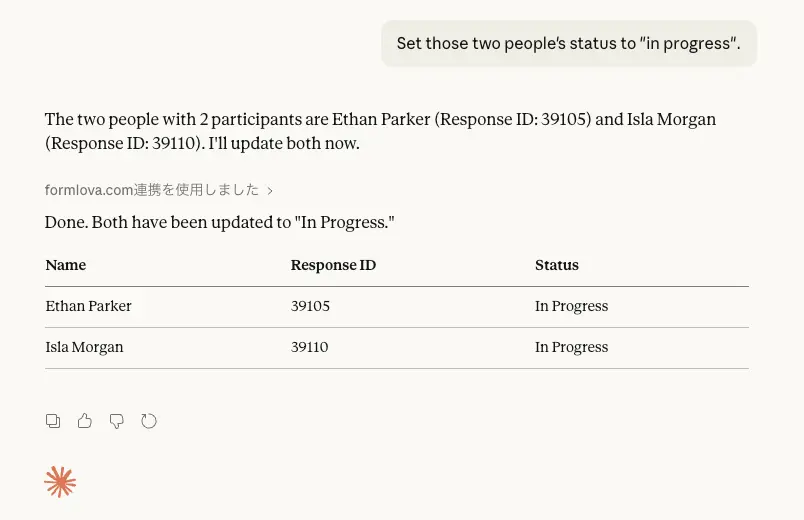
After reviewing those two responses, the next prompt was:
Change those two to In Progress.
FORMLOVA replied:
Updating both now.
Done. Naoki Kobayashi (3/26) and Hanako Suzuki (3/8) were changed to “In Progress.”
That is what completes the workflow. It is not just about viewing responses. It is about moving them forward.
I think that is the most important part of this guide. Listing, filtering, and inspection are useful, but they are usually in service of an action. Once you know which responses matter, you want to update their status right away.
And in this example, it happened in bulk. Not one by one, not through a separate batch interface, but directly through the same chat flow. That is especially useful in event operations and inquiry handling, where several responses often need the same next state.
This Is the Core Flow to Remember
If you want the simplest version of this guide, it is this sequence:
Show me the names from the response list.Show me the names of the people whose participant count is 3.Please show all of their response details.Change those two to In Progress.
That one flow covers the essential pieces of response operations:
- list the responses
- narrow them down by a condition
- inspect the details
- update the status
And because FORMLOVA keeps using the already retrieved data, the conversation stays efficient. You do not have to restart the search every time. You just keep moving deeper until you are ready to act.
That is a strong starting point for post-publish operations. Once the form is live, this is the kind of workflow that makes the product feel useful every day.
Follow the Full Series
Follow the Full Series
- Draft a Form in One Shot with FORMLOVA
- Match a Form Design from a Screenshot with FORMLOVA
- Create and Refine Auto-Reply Emails with FORMLOVA
- Review a Form Before Publishing with FORMLOVA
- View, Filter, and Update Response Status with FORMLOVA
- Export Responses to CSV or Sync Them to Google Sheets with FORMLOVA
- Check the Current Status in Chat and in the Dashboard with FORMLOVA