
Last updated: April 28, 2026
"I want to run an event."
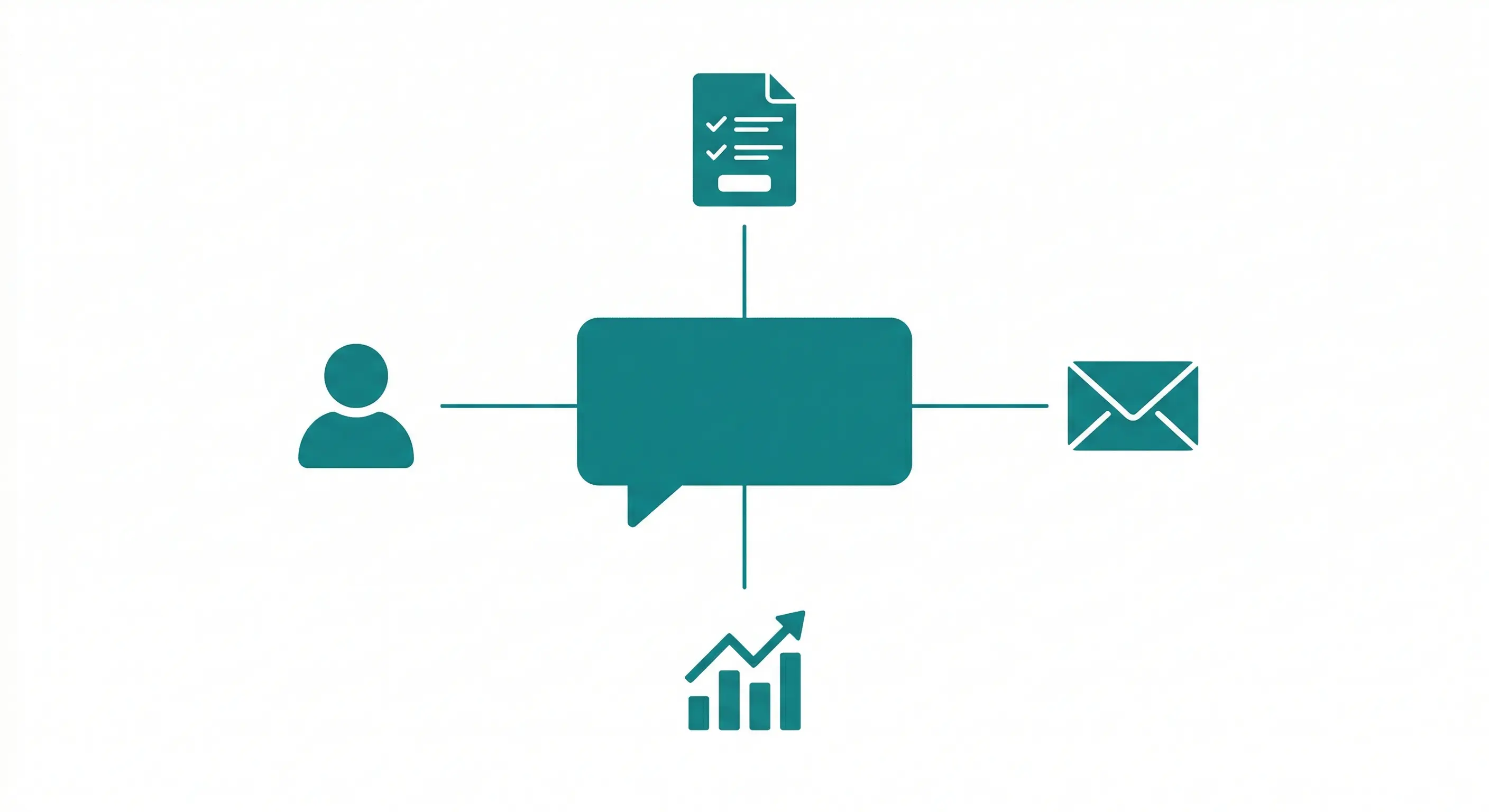
That single sentence should be enough. The form goes live. Registrations come in. Reminder emails go out on schedule. After the event, follow-up messages reach attendees. Analytics sit ready whenever you want them.
All of this, from the same AI chat you already use every day.
FORMLOVA was born from one conviction: the distance between what you intend and what actually gets done should be zero. You say what you want. The system figures out how to get there.
This is the story of how that conviction became a product.
If you want to understand FORMLOVA as more than a form builder, start with the parent MCP form service guide. This article explains the product philosophy underneath that operations layer.
More Tools, Still Fragmented
Before building FORMLOVA, I spent years as a product manager in digital marketing. I watched teams piece together their workflows from a patchwork of tools. One service for building forms. Another for collecting responses. A third for sending emails. A fourth for analytics. Each with its own login, its own interface, its own monthly bill.
The work got done. But the process was exhausting.
Then AI agents arrived. They made individual tasks faster. Draft an email in seconds. Summarize survey responses in a click. Generate a form layout from a prompt.
But the fragmentation stayed.
Each tool still lived in its own world. You still copied data between them. You still juggled browser tabs. You still had to remember which platform held which piece of your workflow.
AI made the parts faster. Nobody connected the parts together.
I kept coming back to the same gap. Someone says, "I want to run an event." That is the intention. The goal is a running operation -- registrations flowing in, reminders going out, attendance tracked, follow-ups sent. Between intention and goal, there was still a maze of disconnected tools.
I wanted to close that gap.
Your Everyday AI Chat, Extended
Here is what using FORMLOVA looks like in practice.
You open your AI chat -- Claude, ChatGPT, whichever one you already talk to -- and type: "I need a registration form for a workshop next Saturday."
The system asks a few questions. How many seats? Should it close automatically when full? Do you want reminder emails before the event? What should the confirmation email say?
You answer in plain language. "30 seats max. Send a reminder the day before. Keep the confirmation email casual."
The form goes live. The link comes back to you in the same conversation.
Two days later, you check in. "How many people signed up so far?" The answer appears. "18 registrations. Here is the breakdown by date."
The morning of the event, you realize you want to add a note to the reminder. "Change the reminder to include the building entrance instructions." Done.
After the event, you type: "Send a thank-you email to everyone who attended." It goes out.
This is not a new interface you need to learn. There is no dashboard to memorize, no settings menu to navigate. You are just talking to your AI the way you already do, and FORMLOVA extends what that conversation can accomplish.
A dashboard does exist. It is there for when you want a bird's-eye view of all your forms, or when you need to scan through response data in a table format. But it is secondary. The daily work happens in conversation.
That division is explained in more detail in Why FORMLOVA Still Has a Dashboard.
One thing I was careful about: the system never guesses when it should ask. If you say "make it look nice," it does not silently apply a random design. It comes back with a question. "Do you have a reference image? Or would you prefer a clean business style, something casual, or minimal?" The interaction stays collaborative. You stay in control.
MCP -- The Conviction
FORMLOVA runs on something called MCP -- the Model Context Protocol. If that sounds technical, think of it this way: MCP is like USB-C for AI systems. It is a standard way for AI applications to connect with external services. The product-level argument is expanded in Why Form Operations Need an MCP Layer.
I first encountered MCP as a developer tool. Connecting my AI assistant to databases, design tools, code repositories. It worked well for technical workflows. But I kept thinking about a different audience.
What if MCP was not just a dev tool? What if it was the interface itself?
There were skeptics. "A command line is enough." "MCP is overkill for most people." "Nobody needs another protocol." I understood the arguments. For developers, existing tools often suffice.
But I was not building for developers. I was building for the person who says, "I want to run an event," and expects the rest to follow.
My conviction solidified when I watched something unexpected happen in Japan. Major accounting platforms -- services used by millions of small business owners to manage invoices, expenses, and tax filings -- adopted MCP. Suddenly, a shop owner could open their AI chat and say, "Show me last month's expenses," and get a real answer from their actual accounting data. No login. No navigation. Just conversation.
These were not technical users. They were people running small businesses, and they were managing their finances through AI chat.
That was the moment. If accounting can work this way, form operations can too. The pattern is the same: take a task that currently requires a dedicated interface, and let it happen inside a conversation the user is already having.
By the time that conviction crystallized, FORMLOVA was about 80 percent built. The remaining work accelerated.
Today, no other independent form platform is built MCP-native from the ground up. Others have added AI features on top of existing interfaces, or created wrappers around established services. FORMLOVA was designed from day one around the assumption that the conversation is the interface.
Safety Took the Most Time
Building tools was the easier part. Controlling them was harder.
Forms collect personal data. Names, email addresses, phone numbers. Sometimes payment information. Sometimes health data. The stakes are not abstract. A wrong email sent to the wrong person is a real problem. Unauthorized access to response data is a real breach.
And chat-first makes safety harder, not easier.
When someone types "send an email to everyone," the system needs to know: everyone on which list? With what subject line? Are you sure? In a traditional interface, these questions are answered by the fields on the screen. In a conversation, the user might skip details. The system has to catch what is missing and ask.
I spent more time on safety than on any other part of the product.
Every operation FORMLOVA can perform is classified into one of four impact tiers. Reading data is tier zero -- it runs immediately, no confirmation needed. Reversible changes like editing a form design are tier one -- also immediate, because version history lets you undo them. Actions that affect respondents, like publishing a form, are tier two. And irreversible operations -- sending mass emails, deleting data, removing team members -- are tier three.
Tier three operations use a cryptographically signed two-step confirmation. When you say "send this email to all 200 registrants," the system does not send. It returns a summary: here is the subject line, here is the opening line, here are 200 recipients, here is the sender address. You review it. If you confirm, the system issues a signed token that expires in five minutes. Only with that token does the operation execute. No shortcut. No override.
This is not a prompt asking "are you sure?" It is a server-enforced gate. Even if the AI model behaves unexpectedly, the backend will not execute a destructive operation without a valid, time-limited, cryptographically verified token.
Beyond the confirmation system, I ran three full security audits over the course of development. They found 151 issues in total. Every one was fixed. The test suite includes 185 journey scenarios that simulate real multi-turn conversations and check for safety violations at every step.
The entire development took about four months. The safety harness -- the confirmation system, the audit fixes, the test scenarios, the tier classification -- consumed the largest share of that time.
I do not regret it. When someone trusts you with their respondents' email addresses, you do not get to be careless.
The Meaning Behind "Lova"
FORMLOVA is not my first product with "lova" in the name.
The suffix comes from "love." It started as a small decision, almost accidental. I was naming a service and wanted something that felt warm. "Lova" stuck. It became a thread that connects everything I build.
Sapolova supports creators and athletes. Lovai is a context-sharing social platform. Molelava tracks e-commerce prices for shoppers. And now FORMLOVA handles form operations.
Different problems. Same principle. Build something kind.
Kindness in a product is not about decoration. It is about not wasting someone's time. Not holding their data hostage. Not making them feel stupid when they cannot find a button. Not surprising them with charges they did not expect.
Kindness is the system asking, "Would you like to send a test email first?" before you blast a message to 500 people. Kindness is returning a clear summary instead of silently executing. Kindness is making the free plan genuinely useful, not a crippled demo.
That is what "lova" means to me.
Your Data Is Not Held Hostage
This matters enough that I want to state it plainly.
Every plan -- including the free plan -- allows unlimited forms and unlimited responses. There is no cap on how many people can fill out your form. There is no limit on how many forms you create.
On the free plan, you can view every response. You can export everything to CSV or Excel. Your data is yours. You can leave anytime and take it all with you.
The free plan covers creation, collection, and viewing. You build forms, gather responses, read through them, export them. That is a complete workflow for many use cases.
The paid plans expand what you can delegate. The standard plan, at around three dollars a month, adds operational features: custom auto-reply emails, reminder scheduling, conditional email sends, detailed analytics, funnel analysis, PDF reports. The premium plan, at around seven dollars a month, adds scale features: mass email campaigns, drip sequences, paid event ticketing through Stripe Connect, and team management.
The pricing axis is not data access. It is scope of automation.
There is one more thing about cost that matters. FORMLOVA itself does not run any AI. The intelligence comes from your AI client -- Claude, ChatGPT, Gemini CLI, whichever you use. That means the AI processing cost sits on the user side, not the service side. As FORMLOVA grows, AI costs do not grow with it. This is how the price stays low.
And there is a pleasant side effect. As AI models get smarter, FORMLOVA gets better automatically. The system does not need to update its AI -- your AI updates itself. Better models mean better form designs, better email drafts, better analytics summaries. The experience improves without anyone shipping a new feature.
Connecting Intention to Goal
FORMLOVA is not a form creation tool.
I know that sounds strange for a service with "form" in its name. But creating a form is just the entry point. The real value is everything that happens after.
A response comes in. It gets routed to the right team member. A confirmation email goes to the respondent, styled with your brand. The data syncs to your CRM. Three days later, a follow-up email goes out automatically. At the end of the week, a summary report lands in your inbox.
None of that is "form creation." All of it is form operations. The form is the front door. The operations are the house.
FORMLOVA has 151 tools organized across 24 categories. Forms, responses, analytics, emails, webhooks, team management, templates, scheduling, A/B testing, CRM integration, email sequences, conditional notifications, and more. Every one of these tools exists to connect one step to the next. Not to exist in isolation, but to bridge.
"I want to run an event."
That intention leads to: a form is published with a 30-person cap. Registrations arrive and are tracked. A reminder goes out the day before. After the event, attendees receive a thank-you email. People who rated the event highly get a link to share. People who gave low ratings get a follow-up asking what could improve. A PDF report summarizes everything.
Intention to goal. Connected through conversation.
And because FORMLOVA runs on MCP, it works alongside other MCP-enabled services on the same AI chat. Your CRM, your spreadsheet tool, your project management system -- if they support MCP, they are already connected. You can say, "Add these respondents to my HubSpot contacts," and the AI orchestrates across both services. No integration to build. No API key to configure. Just a sentence.
The vision is a web concierge. You speak. Things happen in the right order. The system knows what to do next because the tools are designed to hand off to each other.
Who This Is For
If you currently use one tool to build forms, another to send emails, a third to track responses, and a fourth to run analytics -- FORMLOVA was built for you.
If you pay separate subscriptions for each of those services, learn separate interfaces, and copy data between them -- FORMLOVA was built for you.
If you have ever thought, "I just want to say what I need and have it happen" -- FORMLOVA was built for you.
The time you save will be noticeable from the first form you create. Not because the system is faster at any single task, but because the tasks flow into each other. No tab switching. No data copying. No re-entering the same information in a different tool.
You just talk. And things get done.
Get Started
Connect FORMLOVA to your AI chat. Open a conversation and say, "I want to create a form."
That is all it takes.
Related Articles
- MCP Form Service Guide -- From AI Creation to Form Operations
- Form Services Comparison Hub -- Pricing, Alternatives, and Operations
- FORMLOVA Form Automation Guide -- Auto-Replies, Routing, Sheets Sync, and MCP Operations
- Form Creation Guide -- Choose Templates, Fields, and Workflows
- Most Form Tools Stop at Creation -- FORMLOVA Starts After Publish
- SaaS Is Moving from Chosen to Called -- Built-in AI, MCP, and the Shifting Ground Under Software
- Buying Has Moved Into the Conversation -- Why Forms Remain in the Age of Agentic Commerce
FORMLOVA currently works with Claude, ChatGPT, Gemini CLI, Cursor, Codex, and other MCP-compatible AI clients.
Disclosure and Verification
This article is part of the FORMLOVA product blog. The author is the developer of FORMLOVA. Product facts, pricing, limits, and comparison claims should be checked against the current FORMLOVA spec, plan definitions, and relevant primary sources before publication or major updates. For privacy, hiring, legal, medical, or financial workflows, follow your organization's policies and specialist review.