
Business Trip Request Form: Template and Justification Example
A business trip request should explain who will travel, when and where they plan to go, why the trip is needed, and what it is expected to cost. Add the main itinerary, the basis of the estimate, arrangements for work during the absence, and the intended follow-up after returning. This gives the reviewer the information needed to consider the request.
Start with your organization's required form and travel policy when they exist. The template below is an editorial starting point for a request made before travel. Submitting the request, approving it, booking travel, and settling actual expenses are separate steps. Keep that distinction visible in both the form and its instructions.
A travel request is different from an expense claim
A pre-trip request presents a plan for review. It describes the purpose, proposed schedule and estimated spending before the trip happens. An expense claim concerns costs actually incurred and the supporting records required by the organization. An estimated amount is not an amount already paid or automatically approved for reimbursement.
Before writing, check the recipient, submission deadline, cost categories and any approval required before making a booking. Different organizations use different definitions and processes. This guide does not establish a universal daily allowance, accommodation limit, tax treatment or entitlement to payment.
For the later collection of actual spending, use the separate guide to an expense reimbursement form. Here, the task is to prepare the information a reviewer needs before the traveler goes anywhere.
Fields to include in a business trip request
Separate the traveler's proposed arrangements from decisions made by the authorized reviewer. A request field should not let the applicant declare their own trip approved.
| Field | What to record | What the reviewer can check |
|---|---|---|
| Applicant | Submission date, team, name and necessary contact details | Who owns this request? |
| Travel period | Departure, return and important appointment times | Does the schedule fit the work? |
| Destination | Region, site, organization and relevant location | Is the visit sufficiently defined? |
| Purpose | The work issue, planned activity and reason for visiting | Why is this trip proposed? |
| Itinerary | Travel, meetings, site activities and return | Do the activities support the purpose? |
| Estimated costs | Transport, accommodation, other items and total | Can the assumptions be followed? |
| Work cover | Tasks to hand over, agreed contact and availability | Is routine work covered? |
| Follow-up | Planned report, sharing session or next action | How will the findings be used? |
| Reviewer record | Decision, conditions, date and questions | Has the designated person reviewed it? |
Add companions and their roles when relevant. Include personal names and contact details only where they are necessary for the review. A form does not need to collect every visitor's private phone number simply because it has room for another field.
If an appointment or quote is still being arranged, label it accordingly. “Meeting time being confirmed” is different from a confirmed appointment. A note about who will check it and when helps the reviewer identify what is missing from the decision.
Copy-ready business trip request template
You can adapt these headings to a document, spreadsheet or online form. Compare them with the company's required fields before distribution, and remove information that is not needed for your process.
Submission date:
Applicant name and team:
Proposed departure and return:
Destination and organization or site:
Travel companions and roles, if needed:
1. Purpose and current work issue
2. Planned on-site activity and reason for visiting
3. Main itinerary, separating confirmed and tentative arrangements
4. Estimated costs: transport, accommodation, other items, total and basis
5. Work cover and contact arrangements during the absence
6. Planned report or sharing after returning
7. Questions that need confirmation before a decision
[Reviewer record] Decision, conditions, date and reasons for revision
Make ownership of the reviewer section explicit. If you collect the applicant's information through a form, the reviewer can record the decision using the organization's designated process. Merely adding a drop-down with “requested” and “approved” does not create an approval-permission system.
Avoid making the applicant answer questions they cannot know yet. An applicant can propose dates and provide a current quote. They cannot confirm another person's decision before it has been made. When a process depends on a separate team, describe the dependency instead of disguising it as a completed checkbox.
Completed fictional example: checking a partner's work process
The following request is fictional. Its destination, dates and amounts illustrate the writing method. They are not real bookings, recommended prices or a company's reimbursement rates.
| Field | Fictional entry |
|---|---|
| Applicant | Sales support coordinator, Alex, a fictional employee |
| Period and destination | November 18–19, Company B's Nagoya site |
| Purpose | Compare a shared order-checking procedure with the partner's actual work process. |
| Reason for the visit | Check whether the documented steps match the work locations and handover points on site. The scope and appointment are still being agreed with the partner. |
| Itinerary | Travel on the first morning, observe the relevant work areas in the afternoon, discuss differences the following morning, and return that afternoon. |
| Estimate | Return transport JPY 24,000, one night's accommodation JPY 10,000, and local transport JPY 2,000; total JPY 36,000. These are provisional example amounts based on a current estimate. |
| Work cover | A colleague in the same team will handle routine inquiries, subject to confirming that the colleague can take the work. |
| Follow-up | Prepare a summary of differences and unresolved questions for the relevant colleagues by November 24. |
| Open items | Meeting time, booking conditions and the final quote after the schedule is confirmed. Update through the company process. |
This request names the thing to be checked rather than simply saying “partner visit.” It connects the activity on site with a proposed result: a summary of differences and open questions. It does not promise a contract, purchase or financial return that has not been established.
The example also leaves genuine uncertainties visible. The reviewer can decide whether more information is needed before considering the request. Writing a tentative meeting as confirmed might make the form look complete, but it would remove information that matters to the decision.
A trip request should not manufacture a reason why only an in-person visit could work. Consider which questions can be addressed through documents or an online discussion first. Then explain what remains to be checked at the destination. This can help define the scope of the visit as well as its purpose.
A same-day visit can use the same structure in a shorter entry. For example, a fictional request might say: “Visit Company C on November 12 to confirm installation conditions needed for the next proposal. Travel in the morning, meet in the afternoon, and return the same day. Estimated return transport is JPY 6,000 and local transport JPY 1,000, with no overnight stay, for a total of JPY 7,000. Summarize the conditions and open questions after returning.” These figures illustrate the format; they are not recommended prices.
Write the justification as a work question and a planned action
“For a meeting” identifies an activity but leaves the business question open. Explain the current issue, what you intend to do at the destination, and how the findings will be used after the trip. Keep the account factual and proportionate to the decision.
| Vague purpose | Make it more specific by stating |
|---|---|
| Visit a customer | The project, the discussion partner and what needs confirmation. |
| Gather information | The comparison criteria and the work decision the information will support. |
| Strengthen the relationship | The intended discussion, relevant topics and proposed next action. |
| Carry out on-site work | The equipment, process or condition that needs examination and what remains unclear remotely. |
For an exhibition visit, you might write: “Compare equipment against the team's current selection criteria, then share candidate options and unresolved questions at the next selection meeting.” That says what the traveler intends to do. It does not imply that a purchase or business result is already certain.
A longer justification is not automatically better. Choose the facts that help someone assess the request, and identify assumptions that still need checking. Avoid inventing a customer agreement, an operational problem or an expected return simply to make the trip easier to approve.
If several people are traveling, explain their different responsibilities where that affects the request. “Attend with two colleagues” gives less information than naming the tasks each person needs to cover. If those roles are not yet decided, say so rather than assigning work to someone without agreement.
Make estimated costs traceable
Show the cost categories as well as the total. For transport, identify the relevant route; for accommodation, state the number of nights. Include the date or basis of a quote where it affects the estimate. The reviewer should be able to understand how the total was assembled without guessing what it includes.
Separate an unknown cost from a cost of zero. A blank accommodation field might mean a day trip, a booking covered by another party, or an estimate that has not been obtained. A short explanation prevents those different situations from looking the same.
Use the company's categories and calculation method. Do not derive a new allowance or spending limit from this article's example. If the trip involves unusual arrangements, such as international travel, private time within the itinerary or advance payment, ask the relevant company contact which existing procedure applies.
Likewise, keep “estimated,” “quoted,” “booked” and “paid” distinct. A number copied from a booking page is not evidence of a completed reservation. Check the company's approval sequence before spending money or making commitments. The request is information for a decision, not a substitute for that decision.
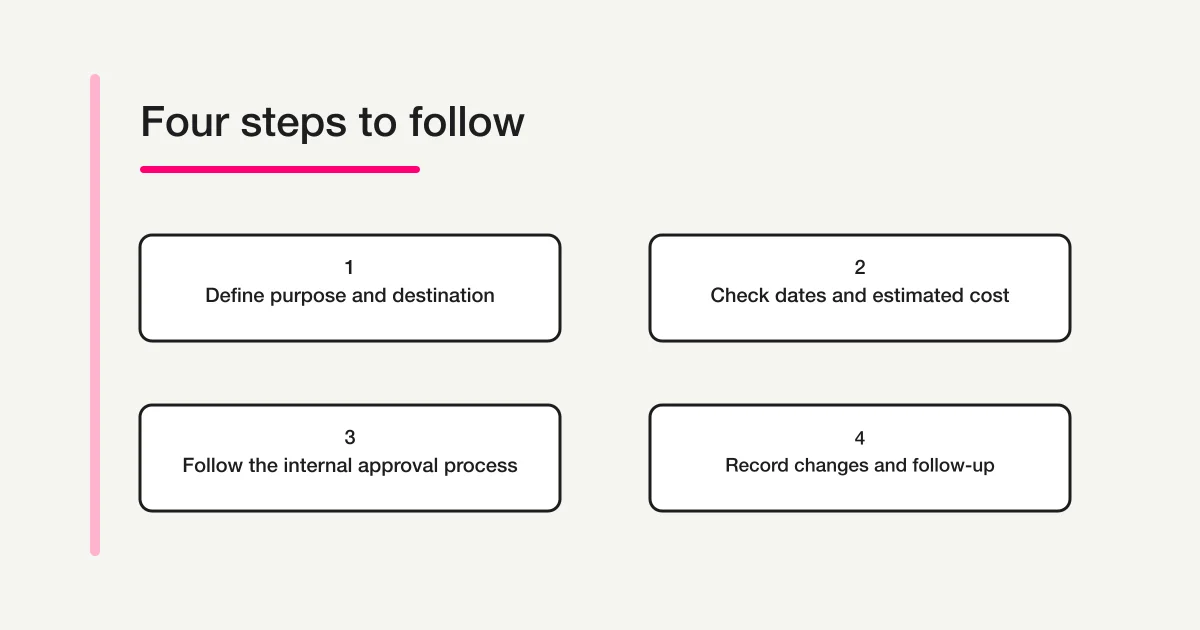
Check the itinerary and work cover before review
Include travel time as well as the meeting itself. Check that departure and return align with the activities described. When the site or meeting time remains tentative, show the uncertainty so that the reviewer can see which part of the plan may change.
For routine work during the absence, agree who can take over the relevant tasks. Writing a colleague's name in a form does not mean that the colleague has accepted the handover. State the tasks, information they need and how questions will be handled while the traveler is away.
After submission, report material changes in a way that makes the changed details easy to identify. A new purpose, destination, period or estimate may need another check under company rules. Do not silently treat an earlier decision as applying to every later version of the itinerary.
For a duplicate request or a cancellation, make the connection to the original submission clear. Agree which version should be reviewed and identify any arrangements already made. Submitting another form, withdrawing a request or canceling the planned trip does not by itself cancel a transport or accommodation booking. The responsible person needs to check the separate arrangements through the existing process.
Draft consistent request fields with FORMLOVA
If requests arrive as differently structured emails, a form can collect the same core information from each applicant. Separate the purpose, itinerary, estimated costs, work cover and open questions so that the person reviewing a request can locate missing information. The form creation guide covers the overall drafting process.
After connecting FORMLOVA to a supported AI chat, you can use a request like this:
Draft an unpublished form for receiving business trip requests before travel. Separate the applicant and team, travel period, destination, purpose and reason for visiting, main itinerary, estimated cost breakdown and basis, work cover, planned sharing after return, and unresolved arrangements. Distinguish tentative plans from confirmed details. Explain that submission does not approve the trip or complete a booking. Do not add attachments, publish the form, send emails, or carry out approval.
This is a suggested request, not a demonstration of a completed operation. Review the resulting draft with a fictional application. Check that departure and return are clear, costs can be read alongside their assumptions, and tentative details do not appear confirmed. See form fields and input types when choosing suitable answer formats.
Draft a request form with purpose, dates and estimated costs
FORMLOVA's Free plan includes form creation and publishing, response collection and search, basic analysis, and CSV or Excel export. Start by reviewing an unpublished draft of your trip-request fields.
Sign up free to draft a business trip request form
After registration, verify your email, connect FORMLOVA to a supported AI chat, and try the request above. Check the AI client's conditions and any separate costs with its provider. Decide who can read requests and how company approval will work before sharing the form.
The form is an intake point. A responsible person still needs to apply company policy and handle approval, booking, payment and expense settlement through the designated processes. Automatic reminders and file attachments are not part of the free scope described here. Check the appropriate plan and information-handling rules if you need them.
Frequently asked questions
How far in advance should I submit a trip request?
Use the deadline and booking sequence set by your organization. There is no universal number of days in this template. If the request may be late, contact the relevant person before delaying submission or making an unapproved commitment.
What if some estimated costs are still unknown?
Separate confirmed estimates from unknown items and record who will obtain the missing information. Explain a blank or zero where it could otherwise be read as “no cost.” The reviewer can then see what remains to be checked.
What should I do if plans change after submission?
Identify the changed details and notify the reviewer through the company's process. Update the request and obtain any required further review. Do not assume that an earlier decision automatically covers a different itinerary or estimate.
Can I use the same form for purchases or training reports?
Some fields overlap, but the decision is different. A purchase request concerns an item and its justification. A training report explains learning after attendance. Keep the distinct purpose visible even if your organization uses shared intake tools.
Related guides
Disclosure and Verification
I develop FORMLOVA. On November 3, 2026, I checked its current plan definitions and form-creation and response-collection specifications. The template, wording, request and diagram are original editorial suggestions. I did not collect or approve a real trip request, make a booking or settle expenses while preparing this article. Use your organization's travel policy and designated application and approval procedures.