
Training Report Template: Writing Tips and a Completed Example
A participant training report should identify the course, explain why you attended, summarize the relevant content, describe what you learned, and set out what you plan to try at work. Keep your reflection separate from the course summary, and distinguish a proposed action from something you have already done.
If you are unsure where to begin, choose one useful lesson and connect it to a real task in your role. Then explain the course activity that helped you understand it and the next occasion when you could use it. The template below gives you a practical starting point, with a fictional example and a way to collect reports through a form. Adapt it to your organization's required format and submission process.
What a participant training report is for
This report helps a participant organize learning and explain it to a manager or development coordinator. It is different from a questionnaire in which the organizer asks about satisfaction, teaching, or future course improvements. If that is your task, use the separate guide to post-training survey questions.
Before writing, check the required format, recipient, deadline, length, and attachment rules. An existing company form takes priority over a general template. Also check whether the reader expects a short attendance record, a reflection on learning, or a proposal for using a new method. Those are different deliverables, even when they share the heading “training report.”
You do not need to reproduce the entire course. A manager usually needs enough context to understand the learning, the connection to your work, and any support you are requesting. Select the parts of the agenda that explain those points. Keep a separate reference to your notes if you need the full detail for later study.
Copy-ready training report fields
Use the following fields as an editable starting point. They are editorial suggestions, rather than a universal official format.
| Field | What to record | A useful check |
|---|---|---|
| Course details | Training name, date, delivery method, participant and team | Can the reader identify the session? |
| Purpose | The task or difficulty you wanted to address | Is it connected to your role? |
| Main content | Relevant topics, demonstrations and exercises | Have you selected the important points? |
| Learning | A method or idea you can explain, with an example | Does it show your understanding? |
| Reflection and questions | A change in your thinking or an unresolved difficulty | Are opinions separate from facts? |
| Application plan | A task, intended action, timing and review method | Is planned work described as planned? |
| Support needed | A question, decision or resource you need | Can the recipient see the request? |
The course summary and the learning section can easily become duplicates. The summary says what the course covered. The learning section explains what you understood from it. “We completed a handover exercise” is a summary. “I learned to state the next action and its deadline separately from the background” explains a lesson from that exercise.
For a document or a form, you can use these headings:
Course name:
Date and delivery method:
Participant and team:
1. Purpose and the work problem I wanted to address
2. Main course content
3. What I learned, with a specific example
4. Reflection and questions still open
5. Where and when I plan to use the learning
6. What I will check after trying it
7. Support or discussion needed
The sections do not need equal space. If the agenda fills most of the report, shorten it to make room for your understanding and next action. If a word limit applies, write the main lesson in one sentence first, then add the course detail needed to support it. This helps you shorten the report without losing its central point.
Completed example: a customer handover course
The course, participant, workplace and actions in this example are fictional. They illustrate the writing method and do not represent a customer result or a measured improvement.
| Field | Fictional report |
|---|---|
| Course | Customer inquiry handover basics |
| Date and format | November 2, an internal classroom session |
| Purpose | During a change of owner, I sometimes leave open questions unclear. I wanted a clearer way to explain what the next person needs to confirm. |
| Main content | Organizing inquiry status, communicating deadlines, and practicing a handover with a fictional customer inquiry. |
| Learning | “Being checked” does not tell the next owner who is checking what. Separating the open question, responsible person and next response date makes the required follow-up easier to identify. |
| Reflection | I have tended to explain the history first and leave the next action at the end. I still need to confirm our team's escalation route when a response date has not been agreed. |
| Application plan | At my next scheduled handover, I will organize open items as “question, owner, next deadline” while following the team's existing handover procedure. |
| Review and support | I will ask the receiving colleague which information was missing. If the shared template needs a new field, I will discuss it with its owner before changing it. |
The report chooses a single practical lesson. It does not claim that attending the course has already improved response quality. The application is still a plan, and the review method describes how the participant intends to learn from trying it.
Notice that the unresolved question is specific: the escalation route when no response date exists. A manager can answer that question or direct the participant to the right person. “I need more support” would make the reader work harder to identify the request.
When adapting this example, use a lesson you can explain in your own words. Do not replace uncertainty with a copied sentence from a slide. If the normal procedure is clear but an exception is not, say so. That gives the reader a better basis for arranging a useful follow-up.
How to write the reflection section
“It was useful” can be an honest reaction, but it does not explain what changed in your thinking. Add the relevant detail: what you previously did, what the exercise showed you, and what remains difficult. You can write positively without pretending that every topic is fully understood.
| Vague sentence | A more specific direction |
|---|---|
| I learned the importance of communication. | In the exercise, repeating the request exposed a difference in our understanding of the deadline. |
| I will use this from tomorrow. | At my next handover, I will state the open question and response deadline separately. |
| I understood everything. | I can explain the basic steps; I still need to check how the exception process works. |
| The training was difficult. | I spent too long identifying the starting assumptions, so I want to prepare a short checklist before the next exercise. |
These are writing examples, not sentences to copy regardless of your experience. A report should reflect what actually happened for you. If you did not understand a point, identify the point and the help you need. If a topic did not apply to your present role, explain the connection you can see or say that no application has been identified yet.
Feedback about the session can also be useful when the report requests it. Describe the condition that affected your learning. “A completed example before the exercise would help me see which fields to organize first” gives the organizer something to consider. Keep that suggestion separate from a judgment about your own understanding or another person's competence.
Turn learning into a realistic application plan
Choose a small action that fits a likely work situation. “Improve the whole department's communication” is a broad aspiration. It does not tell you what to do at the next handover. Start with a task you actually perform, the change you want to try, and a point at which you will review it.
Ask yourself:
- In which task or situation could I use this lesson?
- What would I do differently from my current approach?
- When is the next suitable opportunity?
- What evidence would show that I tried the action?
- What would I review to understand difficulties?
- Who needs to agree before I change the process?
For a customer-service course, a small plan might be: “The next time I explain a product, I will ask about the customer's intended use before choosing the example. Afterwards, I will note what I was able to clarify and which question felt difficult to ask.” That is more actionable than a general promise to improve service.
Do not invent an improvement percentage to make the plan appear measurable. Unless an agreed measure already exists, a clear observation or a review conversation may be a more honest starting point. A planned action is not proof of learning transfer, and a submitted report is not a skill assessment.
Some actions require permission or coordination. Training does not authorize a participant to change a controlled procedure, disclose customer information, or edit a shared template. “Discuss the proposed change with the process owner” can be the right first action. State the dependency so that the manager can help rather than interpreting a delay as a lack of effort.
If there has been no opportunity to try the lesson, record that separately from an unsuccessful attempt. “No relevant customer case occurred this week” and “I tried the method but could not finish the explanation” need different follow-up. You can plan a later review when a suitable opportunity is expected.
Choose between a document and a form
A company document may be sufficient when one participant needs to submit a detailed report to a manager. It gives the writer room for longer analysis and diagrams. A form becomes useful when several participants need the same headings and a coordinator needs to collect and review their submissions. Choose the format for the actual reporting task, rather than changing an established process simply because a form is available.
Before replacing a document, confirm which fields the recipient needs and how approval will work. A participant submitting information should not be treated as a manager approving it. Preserve any required review step when changing the collection method.
Collect consistent training reports with FORMLOVA
When several participants submit reports, a form can give them the same headings while leaving room for individual reflection. Separate the course purpose, learning, questions and planned action instead of placing everything in one large comment box. The guide to form fields and input types explains how to choose suitable answer formats.
After connecting FORMLOVA to a supported AI chat, you can ask for an unpublished draft:
Draft an unpublished form for participants to submit a training report. Separate the course name, date, team and participant name, purpose, main content, learning, reflection and questions, planned workplace action, intended timing, and review method. Let participants describe actions as planned when they have not tried them yet. Explain that they should leave out unnecessary personal information such as customer names. Do not add attachments, publish the form, or send emails.
This is a suggested request, not a demonstration of an executed operation. Review the resulting draft with a fictional report. Check whether the fields make it easy to distinguish the course summary from personal learning and future plans from completed work. Adjust identification fields to the information the report genuinely needs.
Collect learning and action plans in a consistent format
FORMLOVA's Free plan includes form creation and publishing, response collection and search, basic analysis, and CSV or Excel export. Start with an unpublished training report draft and review its fields before sharing it.
Sign up free to draft a training report form
After registration, verify your email, connect FORMLOVA to a supported AI chat, and try the request above. Check the AI client's conditions and any separate costs with its provider. Decide who will receive and read reports before distribution.
Automatic reminders and file attachments are not included in the free scope described here. If you need them, check the relevant plan and your organization's information-handling rules. Collecting a report does not automatically approve it, confirm competence, or show that the action plan has been completed. Assign a person to review the content and agree on any support or next check.
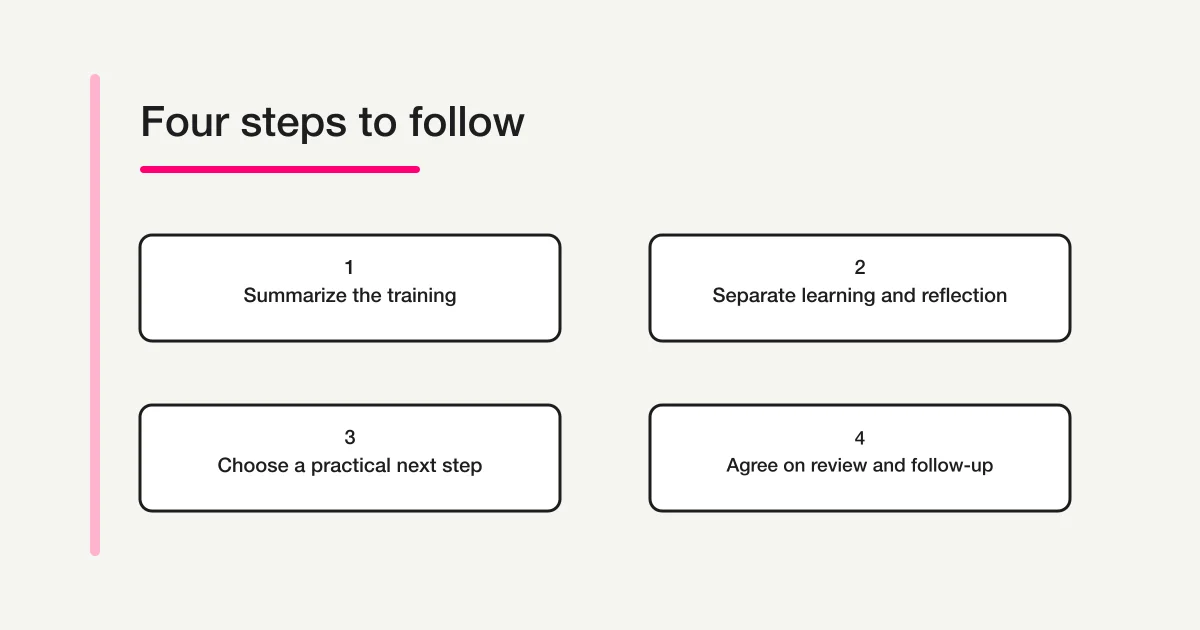
For the overall drafting process, see the form creation guide. Keep the initial form focused on the participant's report. A manager's later review can follow the organization's existing process rather than appearing as a field that the participant must complete on someone else's behalf.
Check the report before submitting
Confirm the required recipient, deadline and format. Check the course name and date, then read the report once for the distinction between course content, your understanding and future work. If you refer to course materials, follow the organization's rules for attribution and sharing. Receiving a slide deck does not by itself establish permission to reproduce it elsewhere.
Remove unnecessary customer names, personal contact details and confidential examples. A case discussed during a course may still have restricted sharing conditions. Give the recipient the information needed to understand your learning without including details that serve no reporting purpose.
Finally, make the requested support visible. If you need a process owner to answer a question or a manager to arrange practice time, say what you need and why. This allows the report to lead to a useful conversation rather than simply becoming a record that attendance occurred.
Frequently asked questions
Are learning and reflection the same thing?
Learning describes the knowledge or method you understood. Reflection connects it to your previous experience, a change in your thinking, or a question that remains open. If the company form combines them in one field, separate them into short paragraphs so that both points remain clear.
Do I need to describe every course topic?
Follow any specific requirement. Otherwise, select the topics relevant to your purpose and role. A useful report explains what you learned and how you might use it; it does not need to reconstruct every slide or activity in the session.
What if I have not used the learning at work yet?
State that it has not been tried and identify a possible opportunity. Include dependencies such as approval or access to a relevant task. You do not need to report a result before one exists. Agree on an appropriate later check if follow-up is needed.
Can this be part of my daily work report?
Your organization can combine the documents, but retain clear headings for the course, learning and application plan. Ordinary progress, blockers and next tasks have a different purpose; the daily report format guide covers that separate reporting task.
Related guides
Disclosure and Verification
I develop FORMLOVA. On November 2, 2026, I checked its current plan definitions and form-creation and response-collection specifications. The template, sample wording, request and diagram are original editorial proposals. I did not collect reports from actual participants, demonstrate a live form-creation operation, or measure a learning outcome while preparing this article. Use your organization's required format and approval process when one exists.