
Improvement Proposal Template: Fields and a Completed Example
An improvement proposal should describe the current problem, a possible cause, the proposed change, required resources, expected benefits, and the conditions for a small trial. Its purpose is to give reviewers enough information to consider an idea before committing to it.
Use the blank template below to separate what you observed from what you still need to check. Submitting a proposal does not mean that it has been approved or implemented. An expected benefit also remains an estimate until you have evidence from the change.
Copyable improvement proposal template
Copy this outline into a document or spreadsheet. If your workplace has a required format, use its headings and add any missing information in the appropriate place. Write “not yet checked” when necessary rather than inventing a value to complete every box.
Proposal title:
Date submitted:
Proposer, department, and contact:
Review contact or designated intake point:

1. Current problem:
   Task, location, and circumstances:
   Observed facts and recording period:
   Information not yet checked:
2. Possible cause, clearly marked as a hypothesis:
3. Proposed change, from current method to suggested method:
   What this proposal will not change:
4. Required people, preparation time, supplies, and cost:
   State whether each figure is quoted, estimated, or unknown:
5. Expected benefit, not a measured result:
   What should change:
   Reasoning and assumptions behind the expectation:
6. Proposed trial:
   Scope, duration, and people to consult before starting:
   What to record, recording method, and proposed recorder:
   Conditions for stopping or restoring the previous method:
7. Evaluation:
   Comparable conditions before and during the trial:
   Review date and person to discuss the outcome with:
8. Questions requiring a reviewer's attention:

Record after review, initially undecided:
- Decision, reason, date, and reviewer:
- Additional information and person to consult:
- Scope and conditions if a trial is authorized:
You do not need to establish the final cause before raising a useful proposal. You do need to make uncertainty visible. “Supplies are difficult to locate, possibly because storage is split between two cupboards” gives a reviewer both an observed problem and something that can be checked.
Keep one main problem in each proposal. Combining office supply storage, meeting preparation, and document filing makes it difficult to assess the resources and benefits of any one change. Separate ideas can still refer to the same broader objective without becoming one large commitment.
Start with the problem, change, and benefit
A proposal sheet published by Chutoku Group in its company newsletter separates the current problem, improvement idea, and effect. The original template in this article adds assumptions, resources, and trial conditions to help reviewers consider an idea before implementation.
| Field | Information the reviewer needs | Keep separate from |
|---|---|---|
| Current problem | Where the difficulty occurs and what was observed | A general impression presented as a fact |
| Possible cause | Why you think it happens and what remains uncertain | A confirmed explanation |
| Proposed change | What would change and what stays outside scope | An instruction already agreed with a worker |
| Resources | Preparation, people, supplies, and estimated cost | Approved spending or assigned work |
| Expected benefit | The hoped-for change and its assumptions | A result already achieved |
| Trial and evaluation | Scope, records, comparison, and review point | A decision to roll out the change everywhere |
Replace broad descriptions such as “the system is inconvenient” with a specific task and situation. Say who encountered the difficulty and during which period. Avoid extending one person's observation into “everyone has this problem” unless you have evidence for that wider claim.
A useful title names the change being considered. “Review shared stationery storage and replenishment records” tells a reviewer more than “Office efficiency proposal.” The title can be short while the body explains the boundaries.
Completed example: shared stationery storage
The following example is fictional. Every person, period, count, amount, and resource estimate is an editorial illustration, not a real measurement or implemented improvement. It concerns consumable supplies and replenishment, rather than equipment lending or return tracking.
| Field | Fictional completed example |
|---|---|
| Title and proposer | Review the location of shared envelopes and sticky notes. Submitted by office administrator A to the general affairs intake point |
| Current problem | Supplies are split between two cupboards. People sometimes search the second cupboard after not finding an item in the first. A fictional baseline record lists eight repeat searches over five business days |
| Unknown information | Whether the same pattern occurs in busy weeks or other departments has not been checked |
| Possible cause | Fixed locations may not be clear, and people cannot easily see which cupboard was replenished |
| Proposed change | Place the selected supplies in one cupboard, label their fixed positions, and record the item and date when replenishing |
| Outside scope | Suppliers, purchasing thresholds, and storage in other departments would remain unchanged |
| Resources | A fictional estimate of JPY 500 for labels and 30 minutes of preparation by one proposed person. Spending and responsibility are not approved |
| Expected benefit | Fewer repeat searches are expected. The reduction in time and count is unmeasured. Maintaining the replenishment record could add work |
| Trial | After consultation, consider one cupboard for 10 business days. No start date has been agreed |
| Evaluation | Compare the same supplies over equal business-day periods, recording usage circumstances, repeat searches, and time spent maintaining the record |
| Stop and review | Consult the intake contact and restore the previous arrangement if people cannot access necessary supplies. Review continuation, revision, or rejection after the trial |
The proposal describes a change without pretending it has already been accepted. The preparation estimate does not assign someone to do the work. The trial duration is a suggestion to discuss, and the expected benefit is explicitly unmeasured.
If another approach is plausible, add a short comparison. For this example, an alternative could keep both cupboards and add matching location notices. Compare preparation effort and the effect on users. A proposal can recommend an option while acknowledging that the reviewer has not decided.
Separate observations from possible causes
A problem statement should help another person understand what happened without requiring them to accept your explanation immediately. “The item was not in the first cupboard checked” is different from “people do not follow the rules.” The latter attributes a cause that may not have been investigated.
Look first at things you can check: labels, agreed storage locations, replenishment records, and how changes are communicated. A cause field might say, “The absence of a shared location guide may contribute; users have not yet been consulted.” That is specific enough to investigate without presenting an assumption as established knowledge.
Record what you have not checked as well. If the fictional baseline covers only a quiet week, say so. If only one cupboard was observed, do not apply the count to the whole office. These limits help a reviewer choose a sensible next step.
Write expected benefits without inventing results
“Improve efficiency” is an objective, but it does not explain what you would look for. In the stationery example, the useful question is whether repeat searches decrease without creating excessive replenishment-record work. That gives you both a hoped-for benefit and a possible tradeoff.
A numerical estimate can be helpful when its inputs and assumptions are visible. For example, if a repeat search hypothetically takes two minutes and four searches were hypothetically avoided per week, the expected saving would be eight minutes per week. Those are assumed inputs, not observed results or a promise of savings.
If you do not know the frequency or duration, make establishing those values part of the trial. There is no need to manufacture an annual financial benefit for a proposal that is still being explored. A clearer location and fewer interruptions can be worth examining without an unsupported currency figure.
Include the new work too. Preparing labels, explaining a changed location, and maintaining a record all take time. Counting only the activity that disappears could make a proposal look successful while merely transferring work to someone else.
Define the trial and comparison before starting
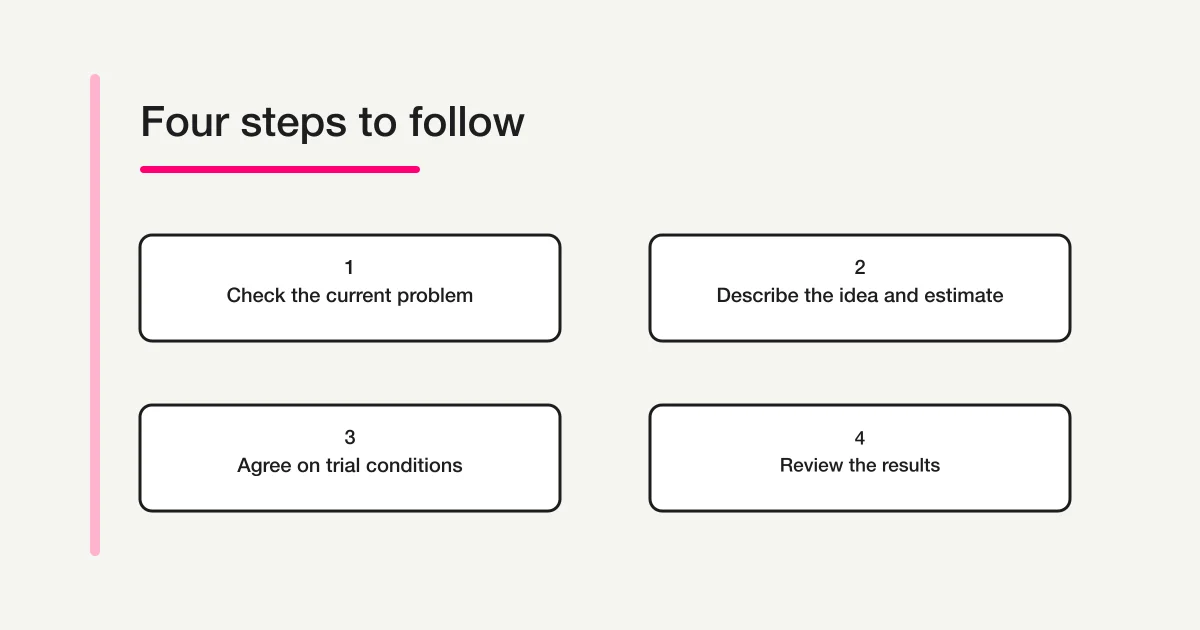
A small trial still needs a scope, duration, consultation point, and recording method. Without those, the discussion may end with “it seemed easier” and no shared understanding of what changed. Decide what information would support continuation and what would require revision.
Equal recording periods help, but context also matters. Office attendance, visitor activity, and supply usage may differ between weeks. Record unusual circumstances beside the counts so reviewers can see whether a comparison is limited. A difference after a short trial does not, by itself, establish that the change caused it.
Choose a practical recording method. Counting repeat searches may be manageable; asking every employee to time every movement may cost more than it reveals. Discuss who can record the information and whether they have agreed to do so. A proposed recorder is not an assigned owner.
Include a way to stop. In the example, difficulties accessing essential supplies would trigger consultation and restoration of the previous arrangement. State who should be contacted and what can be restored. Follow your workplace's designated review process before beginning the trial.
At the review point, consider more than permanent adoption. You might revise the labels, narrow the supplies included, extend the observation period, or return to the previous method. Record the reason and any remaining uncertainty so that another reviewer can follow the decision later.
If a meeting determines the next step, use the meeting minutes template to distinguish decisions, open questions, and follow-up actions. An idea still under discussion should remain visibly undecided.
Collect consistent proposals with FORMLOVA
When several departments submit ideas, collecting the problem, change, expected benefit, and trial conditions in the same fields can help reviewers compare the information. See the form creation guide for the broader design process and form field examples for choosing input formats.
After connecting FORMLOVA to a supported AI chat client, you can use this prompt to request an unpublished intake draft:
Create an unpublished draft form for workplace improvement proposals. Use separate fields for the title, proposer and department, task affected, observed problem and recording period, unknown information, possible cause, proposed change, excluded scope, required people and cost, unmeasured expected benefit, trial scope and duration, comparison measures, stop conditions, and review contact. Explain that a possible cause is a hypothesis and an expected benefit is not an achieved result. Do not request attachments or passwords. Do not publish, send notifications, approve proposals, assign people, or start a trial.
This is a sample prompt, not a transcript of an actual output or an approved proposal. When you have a draft, test it with the fictional stationery example. Check that an observation and a hypothesis fit in different fields, and that the benefit field clearly accepts an unmeasured estimate. Allow “not yet checked” where appropriate rather than forcing a speculative answer.
Draft an intake form that separates problems from expected benefits
FORMLOVA's free plan includes form creation and publishing, response collection, response search, basic analytics, and CSV or Excel export. Start by reviewing an unpublished draft for comparable workplace improvement proposals.
Sign up free to draft an improvement proposal intake form
Register, confirm your email, and connect FORMLOVA to a supported AI chat client before trying the prompt above. Check the AI provider's access requirements and any separate costs.
A submitted response records proposal information. It does not establish adoption, approved spending, an assigned worker, an active trial, or a realized benefit. This example uses text fields within the free scope; it does not depend on attachments or automated reminders.
Keep receipt and review outcomes separate
Record when a proposal was received separately from what a reviewer decided. If information is missing, note the question and the person to consult. If the idea is on hold, record what would allow it to be reviewed again. Silence should not be interpreted as either approval or rejection.
When an idea changes, make the revision visible. A trial in a different cupboard may affect different users. Agreement to the earlier scope does not automatically cover the new one. Preserve the previous scope, identify the change, and seek the appropriate review of the revised conditions.
Once a proposal is adopted and a specific task needs to be requested, the work request template helps define the deliverable, requested deadline, and recipient confirmation. Start here with one problem, a clearly labeled hypothesis, a proposed change, and a way to evaluate it.
Frequently asked questions
Can I submit a short idea first?
For an initial conversation, a brief description of the difficult situation and the change you suggest may be enough. Before a review, add the facts you have checked, the effort required, and the information still missing. The aim is to make the next question clear, rather than to fill every field with a confident answer.
What if I cannot express the benefit as a number?
An unmeasured benefit is different from no benefit. Describe the state you hope to achieve, such as finding supplies without asking another person, and discuss a practical way to check it. Add measured results later. Do not turn an assumed time saving into a reported achievement.
Can I use a document and an intake form together?
A document can explain one idea in detail; a form can collect several ideas in comparable fields. If you use both, identify the authoritative version and make revisions traceable. Receiving the information and reviewing the proposal remain separate steps, whichever format you choose.
Disclosure and Verification
The author develops FORMLOVA. The current plan definition, form creation and response collection specifications, and Chutoku Group's public PDF were checked on November 7, 2026. The template, fictional example, prompt, and diagrams are original editorial suggestions. This article does not report an actual improvement, adoption, or measured benefit. Adapt it to your workplace's required format and review process. Safety, medical, legal decisions, and automated approval are outside its scope.