
To copy a Google Form, open it in the editor, choose More → Make a copy, and give the new form a name. Choose its Drive location and whether to share it with the same collaborators, then confirm. If you only need a few questions, use Import questions in the destination form instead.
That creates the starting point for your next event. Before distributing it, review the things that belong to this particular event: dates, audience, organizers, response storage, and the link people will actually open. A form can look familiar while still directing someone to last month's instructions.
Last verified: September 22, 2026
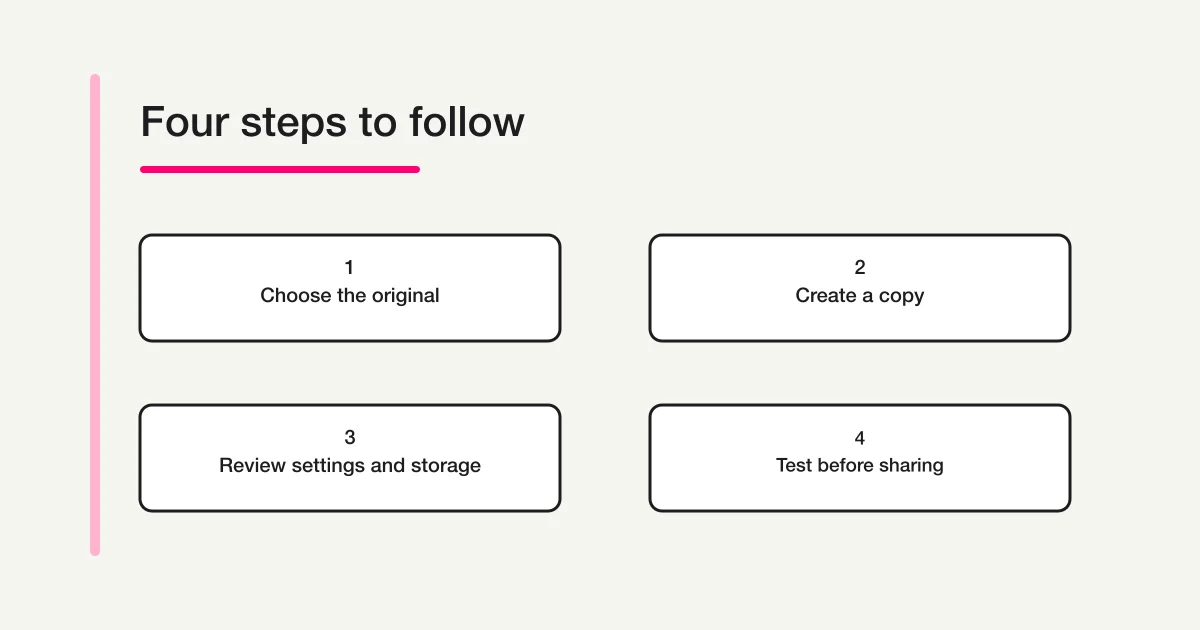
Decide what you want to reuse
Start with the unit of work. A whole-form copy is useful when the overall structure remains appropriate and only the event details change. Importing questions is useful when the destination already has its own purpose and you want a small set of reusable fields. Saving response records is a separate job.
| Your goal | Appropriate starting point | Your next check |
|---|---|---|
| Run the same registration process next month | Make a copy | Event details and release settings |
| Reuse contact questions in a different form | Import questions | Relevance, order, and required fields |
| Add a similar question inside one form | Duplicate the question | Wording and answer options |
| Preserve last month's submissions | Review response storage separately | Record completeness and retention |
This distinction helps you avoid unnecessary editing. Suppose you are building an application for a new mentoring program. Copying a previous workshop registration may bring along questions about lunch, accessibility at a particular venue, and workshop sessions. Importing only the useful contact questions gives you a smaller starting point to review.
If this is your first form, the general Google Forms guide covers the broader creation process. This article focuses on an existing form becoming the starting point for a new run.
Make a copy of the entire form
Google's documented process is to open the source form, use the upper-right menu to make a copy, name the new file, and optionally change its location. The copy dialog also offers a choice to share it with the same people. Review that choice before confirming. Google Workspace copying instructions
Name the destination for the work it will do. “October customer workshop — registration” is easier to recognize than “Copy of September registration.” File names are especially useful when several browser tabs are open or when another organizer needs to identify the correct form in Drive.
After creating the copy, close the source tab while you edit the destination. That is an operating recommendation, not a Google requirement. If you need the source visible for comparison, keep a short note of which tab you are editing. The point is to make accidental edits to the previous event less likely, without creating a complicated approval system for a simple task.
Then read the destination as a participant would. The file name is only one place an event appears. The visible heading, introduction, individual questions, answer choices, and final instructions may each contain event-specific information. Work through those surfaces before assuming the copy is ready.
Import questions when the destination has a different purpose
In the destination form, open Import questions, select the source form, check the questions you want, and import them. For a similar question within the same form, use the question's duplicate control. Google documents these as separate editing actions. Google's question editing and reuse guide
After import, review why each question belongs in this particular form. A field that was required for an employee survey may be unnecessary for an open community event. Keeping it required simply because the earlier form used it can create a question that participants cannot answer meaningfully.
Consider a mailing address field. A previous event may have shipped printed materials, while the new event is entirely online. Reusing the field is easy, but removing it may better fit the new process. This is an editorial decision about the current task, not a claim that importing questions automatically improves a form.
Also read the imported question in its new surroundings. “Which session would you like?” only makes sense if the available sessions are explained nearby. An answer choice referring to “the option above” may no longer point to the same information. Review the sequence as a conversation rather than checking fields in isolation.
If you change page boundaries or branching, use the Google Forms sections guide for the detailed structure checks. Having every question present does not prove that every participant can reach the questions relevant to them.
Treat response records as a separate responsibility
Do not use the form-copy step as proof that you have backed up the previous event's responses. Google's copy instructions describe creating a new form based on an existing one. They are not a complete backup procedure for response history, files, and external processes.
Before changing or retiring the original, establish where its records are kept and who is responsible for retaining them. Then inspect the destination's Responses area and choose how the new run will be monitored. Google documents selecting either a new spreadsheet or an existing spreadsheet as a response destination. Google's response destination guide
For an event-by-event process, give the destination form and response file matching identifiers. For example, “October workshop — registration” and “October workshop — responses” make the intended relationship visible. This naming convention is a recommendation; it does not configure or verify the connection by itself.
If your team prefers consolidated reporting, write down how it will distinguish each event. A consolidated view can be useful, but someone still needs to know which submissions belong to which run and where to investigate a discrepancy. Avoid introducing a reporting structure merely because a previous organizer happened to use it.
Do not delete the original's records just because the new form exists. Opening a new registration period, closing an old one, exporting records, and deleting records are separate decisions. Handle each according to the event's actual needs and your organization's retention arrangements.
Review collaborators and participant access independently
Two questions need different answers: who should maintain the form, and who should be able to submit it? An organizer leaving the project should not remain involved merely because the copy dialog offered to reuse the same collaborators. Likewise, a participant receiving an invitation does not need an editing link.
Google also warns that collaborators may have access to a linked response spreadsheet, and that removing access can require changing permissions on both resources. Review the form and its response file independently when responsibilities change. Google's collaboration guidance
A practical handoff can be brief. Record the person maintaining the questions, the person checking registrations, and the person preparing the final attendance list. In a small organization those may all be the same person. What matters is that the responsibility is deliberate and that each shared resource matches it.
Pay particular attention when an external agency prepared the original form. The agency's editing role during setup and its need to access subsequent responses are different business decisions. Reusing a file should prompt that conversation again if the scope of the work has changed.
Keep editor links out of participant-facing notes. Store the maintenance location where the team expects to find it, and take the participant link from the destination form when preparing the invitation. Clear names and clear audiences reduce the amount of interpretation the next organizer has to do.
Build a change list for the next event
The following example is for a recurring customer workshop. It is an original operating checklist, not a description of settings Google changes automatically when you copy a form.
| Surface | Example change | Evidence you want |
|---|---|---|
| Heading and introduction | September becomes October | The participant can identify the current event |
| Date, time, and venue | Morning session at a different location | Every relevant description agrees |
| Answer choices | Remove expired sessions | Only current options remain |
| Completion instructions | New contact and follow-up date | The instructions fit the new run |
| Response destination | October's records | A recognizable test arrives there |
| Distribution materials | Invitation, website, QR code | Each opens the intended destination |
Search for the old date, but do not stop there. Relative wording such as “next Friday,” “the usual room,” or “bring the same documents” may depend on context the new audience does not have. Read the form from beginning to end without relying on the previous invitation.
A useful review question is: could someone who has never attended before decide when to arrive and what to prepare using only this form and its current invitation? If the answer depends on last month's email, add the missing information to the current materials.
Changes can also remove work. If there is no meal this time, remove the meal selection rather than relabeling it as optional. If there is one session instead of three, consider whether a session choice still serves a purpose. Reuse should preserve useful structure, not every historical field.
For a broader redesign of registration questions, see the Google Forms registration guide. Here, the goal is narrower: identify what must change before an existing structure can support the next run.
Verify publication and the destination link
A successful copy operation does not establish that your intended participants can respond. Inspect the destination's publication state and responder access rather than assuming a particular state immediately after duplication. Google's current help separates publication from sharing with respondents. Google's publication and sharing guide
Retrieve the participant link from the destination. If you are reusing an invitation email, replace its link deliberately. It is possible for every visible date in the message to be current while the button still points to the earlier event.
Apply the same check to QR codes and website embeds. Their appearance may give you little information about the underlying destination. Open the actual code or embedded form that the participant will encounter, then compare the event name and details with your change list.
Test under the conditions of your intended audience. An editor's preview can help review content, but it does not replace checking the distributed link with an appropriate participant account. If the audience includes people outside your organization, a test limited to an internal account leaves that access question unanswered.
When you make a test submission, use recognizable test content and confirm where it appears. Record that you observed a submission in the intended destination. That is a specific release check, not evidence that all integrations or every future participant's device have been tested.
Keep a reusable original when events repeat
Copying the immediately previous event is convenient, but it can carry forward one-off changes. An emergency contact question added for a particular trip, for example, may stay in the next workshop even when it no longer has a purpose.
A maintained original offers another approach. Keep the stable questions there, and create event-specific forms from it. Store a short companion checklist of the details that always need attention: event date, organizer, response location, access, and distribution materials.
Avoid leaving editing instructions in text participants will see. A placeholder such as “INSERT DATE HERE” may be useful during preparation, but someone must verify it is gone before distribution. A separate preparation note can make that obligation easier to track without adding clutter to the form itself.
When you improve the original, decide separately whether any existing event copies need the same change. Do not assume that updating the original updates every form already created from it. Identify the active runs and apply only the changes they need.
The Google Forms, Sheets, and GAS operations overview discusses the broader process around the form. It is useful when your recurring task includes several records, owners, and follow-up steps beyond the questions themselves.
Preparing the next run in FORMLOVA
FORMLOVA provides a conversational duplication operation for forms you own. The current implementation creates an unpublished copy with fields, design, and email templates. It does not copy response data, event dates, or reminders; the deadline also needs to be set for the new run.
A request might be:
Duplicate this workshop form for the next session. Keep it unpublished while I check the date and deadline.
That expresses both the reuse task and the next review step. It does not mean the form is already ready for participants.
Review copied email templates as well. Their content may still mention the previous date, location, or organizer. The ability to carry a template forward does not establish that its wording fits the next event. This describes duplicating a form already in FORMLOVA, not migrating all Google Forms settings and historical submissions.
Frequently asked questions
Can I copy a form from a participant link?
Being able to answer a form does not establish permission to edit or duplicate it. Explain the intended reuse to its owner and agree on an appropriate sharing arrangement. Do not treat a response link as an editing invitation.
Should I reuse the old QR code?
Check its destination. If the new event uses a different form copy, prepare a code for that destination and test the actual code before distributing it. A familiar printed design is not evidence that its embedded link is current.
What should I inspect first after copying?
Confirm the destination name and that you are editing the intended form. Then work through dates, questions, collaborators, response storage, publication, and the participant link. This order is a suggested way to keep the review manageable.
Create your next event form with FORMLOVA
Disclosure and Verification
I develop FORMLOVA. I checked Google's official documentation and FORMLOVA's current specification and implementation on September 22, 2026. I did not perform the Google copying operation or a live submission in an account while preparing this article. The workshop examples and review sequence are original operating recommendations, not measured customer outcomes.