One-on-One Meeting Notes Template: Statements, Facts, and Agreements
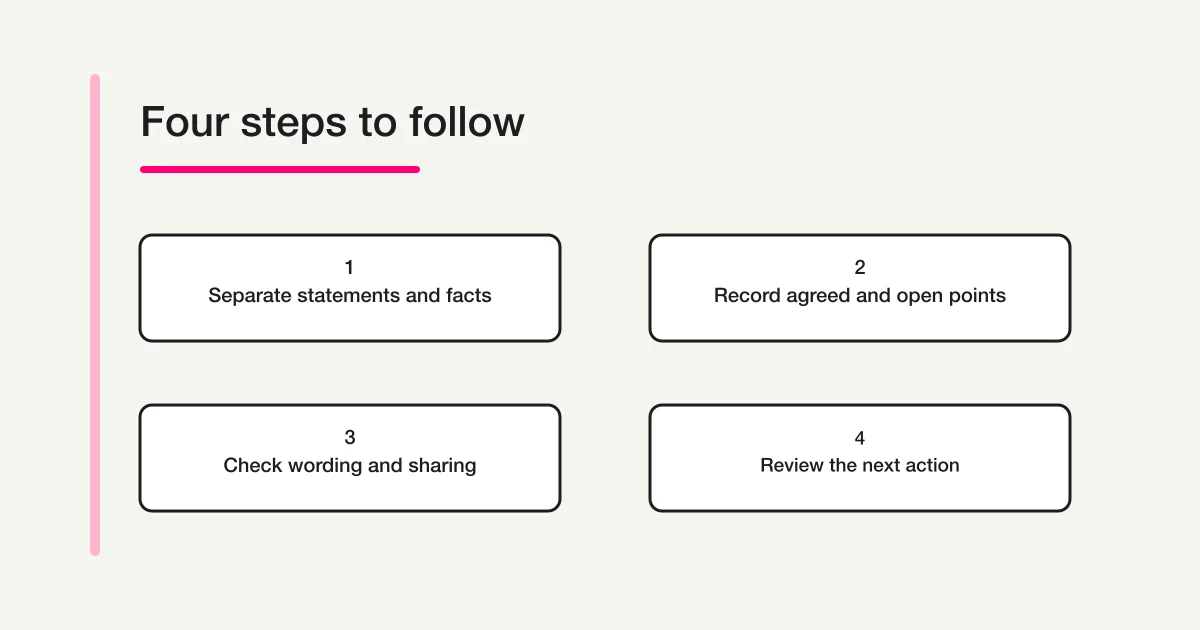
A useful one-on-one meeting record includes the date, participants, purpose, what the person said, verified facts, agreements, open questions, and the next action. For a workplace conversation, keep a separate record of which wording the person checked and what may be shared with whom. A discussion, a confirmed summary, and an agreed action are different stages.
Copy the blank template below and use it for one conversation. It works as a paper note or a document before you consider a form. The completed example follows a fictional discussion about competing work tasks, using the same fields so you can see where uncertainty remains.
Copy this one-on-one meeting notes template
This is a record to review after a workplace conversation. It is not a transcript, a performance rating, or a substitute for a specialized personnel process. Its purpose is to make the person's account, the facts checked together, and the next conversation easier to distinguish.
WORKPLACE ONE-ON-ONE RECORD
Date and time:
Participants: person / meeting lead
Purpose or topic for this conversation:
Previous follow-up and what has since been checked:

Person's statements and requests: who said what?
Verified facts: period, evidence, and who checked it
Meeting lead's interpretation or proposal: kept separate from facts
Agreements: who agreed to what?
Open questions or points where views differ:

Next action: task / owner / planned check date
Wording check with the person:
  not checked / check requested / checked / correction requested
Scope checked, date, and corrections:
Information to share, recipient, and purpose:
Sharing scope checked with the person:
  not checked / checked / further discussion needed
Next conversation or follow-up date:
Remove fields that have no purpose in your setting. At a first meeting, write “First conversation; no previous follow-up” rather than leaving the field unexplained. When evidence has not been checked, keep that limitation visible. A short note saying “Not yet verified” is more useful than a complete-looking sentence built from an assumption.
The wording check can cover only part of the record. For example, the person might check their statement and the follow-up date without reviewing the meeting lead's proposal. Record that scope. “Checked” should not imply that every interpretation was endorsed or that a proposed change was approved.
Give statements, facts, and agreements their own sentences
“Workload is too high” leaves an important question unanswered: whose conclusion is it? The person may have described a particular difficulty, the meeting lead may have inferred a cause, or both may have checked a work list. Use the subject of the sentence to make that difference explicit.
| Type of information | Example wording | Keep separate from |
|---|---|---|
| Person's statement | The person said that morning inquiries interrupt time reserved for quotes. | An explanation inferred by the meeting lead |
| Verified fact | Both participants reviewed the selected week's work list and found outstanding quotes. | An unmeasured claim about frequency or impact |
| Meeting lead's proposal | The lead suggested rotating the morning inquiry role. | A decision to implement the rotation |
| Agreement | Both agreed to review examples of overlapping tasks at the next conversation. | Approval for staffing or budget changes |
| Open question | The effect of a rotation on other colleagues still needs checking. | An assumption that everyone can accommodate it |
If you use a short direct quotation, preserve its meaning and make clear who spoke. If you summarize instead, label it as a summary. Avoid turning a description of a work situation into a general judgment about the person. “The person described interruptions during quote preparation” provides a clearer next check than a label about motivation or attitude.
Japan's National Personnel Authority includes examples of clarifying goals and concerns, and recording workplace behavior as facts, in its procedural guide for appraisal conversations. That material concerns public-service appraisal. Here, it is a reference for distinguishing statements from observed information, rather than a claim that the same appraisal process applies to every workplace.
If the difficulty is deciding what to ask before a conversation, the interview worksheet template addresses that earlier step. This page concerns the record after a one-on-one: what was said, what was checked, what remains open, and what happens next.
Completed example: competing inquiry and quotation work
The following conversation is fictional. It uses roles instead of names and introduces no real employee information. The topic is an ordinary work-planning discussion, with no assessment, diagnosis, or claim that a proposed change has already been authorized.
WORKPLACE ONE-ON-ONE RECORD
Date and time: November 10, 10:00–10:25
Participants: person responsible for orders / work lead
Purpose: understand overlap between morning inquiries and quote preparation
Previous follow-up: first conversation; no previous follow-up

Person's statements and requests:
The person said that quote preparation is pushed back when several morning
inquiries overlap. They would like time to concentrate on quotes in the morning.

Verified facts:
Both participants reviewed the selected week's work list and found outstanding
quotes. Inquiry counts by time of day have not yet been collected.

Meeting lead's interpretation or proposal:
The lead suggested rotating the morning inquiry role. Feasibility is not checked.

Agreements:
The person will add examples of overlapping tasks to the work list. Both will
review them next time. No rotation or additional staffing has been decided.

Open questions:
When inquiries cluster, effects on colleagues, and whether a rotation is possible.

Next action:
Person: add overlap examples to the selected week's work list / check November 12.
Lead: identify whom to consult and the steps for reviewing the proposal /
check November 13.

Wording check with the person: check requested
Scope to check: person's statements, agreements, and next conversation date
Check date and corrections: not checked; add after receiving the response

Information to share, recipient, and purpose:
A possible summary for the work coordinator would cover task overlap and the
questions about a rotation. Confirm the content and recipient before sharing.
Sharing scope checked with the person: further discussion needed
Next conversation: November 13, to review the work list and consultation steps
The agreed action is to gather and review examples. The rotation remains a proposal. Keeping those statements apart prevents a later reader from treating the record as permission to change someone else's work. A planned check date also does not show that an action was completed. Add what was actually done when the date arrives.
The example deliberately leaves some questions unanswered. It does not invent inquiry counts to make the account persuasive, infer why a colleague was interrupted, or assign an outcome to people who were not present. You can make a short record useful without making it sound more certain than the conversation was.
Check the wording and the sharing scope separately
When asking the person to review the note, explain what you want checked: “Please review the summary of what you said and the next action, so I can check that I understood you correctly.” If a correction is requested, record the revised wording and the part it changes. Asking for a check is not the same as receiving one.
Treat agreement about an action as another question. The person can correct a statement of fact while still disagreeing with a proposed response. A single “Confirmed” box can hide that distinction. Keep enough room to say “The description was checked; the proposal remains open.”
Be equally specific about sharing. “Relevant people” is difficult to assess later. Identify the proposed recipient, purpose, and information: for example, “Share the work-overlap summary with the work coordinator to discuss whether a rotation is feasible.” The whole conversation does not have to become the shared summary.
A career-conversation preparation sheet published by Japan's Ministry of Health, Labour and Welfare explains an operating approach in which only matters agreed by the person are shared with a supervisor or personnel staff. It comes from a specialized career-support setting. This article uses it as an example of separating a full record from information to share, rather than as a universal legal requirement for an ordinary work discussion.
Choose the storage location, people who can view the record, and retention arrangements according to the purpose and your workplace's applicable rules. A template does not configure access controls or guarantee confidentiality. Do not add health details, family information, or personnel judgments merely because a blank text field could hold them. A fictional work-planning example is enough to test the structure.
Try an unpublished meeting-record draft in FORMLOVA
FORMLOVA lets you create and manage forms through a supported AI chat. Start with an unpublished draft and the fictional work-planning example. The immediate task is to check whether the fields preserve the distinctions in the template. Creating an input form and sharing a real conversation are separate decisions.
The Free plan lets you try form creation and response collection. Your AI client's access requirements and charges are separate. Register, verify your email, connect a supported AI chat, and then use the request below. Registration alone does not automatically create a meeting-record form.
Create an unpublished form draft for recording an ordinary workplace one-on-one after the conversation. Separate date and time, participants, purpose, the person's statements and requests, verified facts and their evidence, the meeting lead's proposal, agreements, open questions, and the next action with owner and planned check date. For the wording check, offer not checked, check requested, checked, and correction requested, with separate fields for the scope checked and corrections. Include information to share, recipient, purpose, whether the sharing scope has been checked with the person, and the next conversation date. Do not turn statements into performance ratings or diagnoses. Do not label a proposal or a saved record as agreement, approval, or completed action. Review the fields using only a fictional discussion about overlapping inquiries and quote preparation. Do not publish, send notifications or email, or copy anything to an external service yet.
This is a request you can copy, not a reported result from a form-generation session. Read the draft the AI actually returns. Check that “Not checked” remains an option, the person's account is separate from the lead's proposal, and sharing is described by recipient and purpose rather than a blanket approval. The form field examples guide can help you choose field formats.
Try a draft with separate fields for statements, agreements, and follow-up
Use a fictional work discussion to try a free form draft that separates the person's account, verified facts, open questions, and the proposed sharing scope.
Sign up free to try a one-on-one record draft
Register, verify your email, connect a supported AI chat, and use the request above to create an unpublished draft. AI client access requirements and charges are separate.
Review one record before changing the routine
Ask a second reader to review a fictional completed note. Can they identify whose account it contains, what evidence was checked, what both people agreed to, and who checks next? If they need an explanation, revise the sentence or field responsible for the gap. Length is less useful than a clear distinction between information types.
At the next conversation, do not automatically mark the previous action complete. Record what happened, what remains unresolved, and whether the plan needs to change. If the date moves, keep the new date and the reason visible. A count of meetings or submitted forms is not evidence that the underlying issue has been resolved.
When you revise a record, keep the change understandable. A note such as “Corrected the requested time from afternoon to morning; the person checked the statement field” shows both the correction and its scope. It does not imply that every other section was reviewed again. If someone already received an earlier version, check which version they have and whether the correction needs to be passed on. Saving a revised record does not establish that the recipient has seen it.
Also keep a later outcome separate from the original account. If a work rotation is eventually introduced, record who authorized it and what was actually changed in the follow-up entry, using the information you have confirmed. Do not rewrite the earlier conversation to make it sound as though that decision had already been reached. The first note explains what was known then; the follow-up explains what was learned or done later. That distinction is useful when a plan changes without either participant having made a mistake.
For a discussion involving several people and a shared agenda, the meeting minutes template may be a better fit. To work out what a form should collect before building it, start with the form creation guide. Choose the record that matches the conversation rather than combining every field into one document.
Frequently asked questions
Do I need to write down every word?
This template is not a verbatim transcript. Summarize enough to preserve the purpose, the person's account, checked facts, agreements, unresolved points, and next action. If shortening a sentence makes a request sound like a decision, add the subject or clarify its status.
Can I mark a proposal agreed after showing the note?
Showing the note does not establish that the wording was checked or that a proposal was accepted. Record the response and scope checked. A correction to someone's statement, confirmation of a fact, and agreement to an action need separate treatment.
Can I use this for recruitment or formal appraisal?
This article covers ordinary workplace discussions about work. Recruitment, formal appraisal, and medical or welfare conversations have different purposes and processes. Check the appropriate specialist format and procedure rather than substituting this template unchanged.
Disclosure and Verification
I develop FORMLOVA and checked its published specification and Free-plan scope when preparing this guide. The product and official references were checked on November 10, 2026. The template and completed record are fictional editorial examples, not evidence of a real conversation, generated form, information-sharing action, or measured improvement.
The National Personnel Authority material concerns public-service appraisal, while the ministry material concerns specialized career support. Their examples are used within those limits. This article does not turn them into general legal duties, retention periods, or appraisal criteria. Start by checking one fictional record for clear statements, facts, agreements, open points, and sharing scope.