
Last updated: October 15, 2026
Original verification record (retained; this rewrite does not re-certify every historical statement): Last verified: September 4, 2026
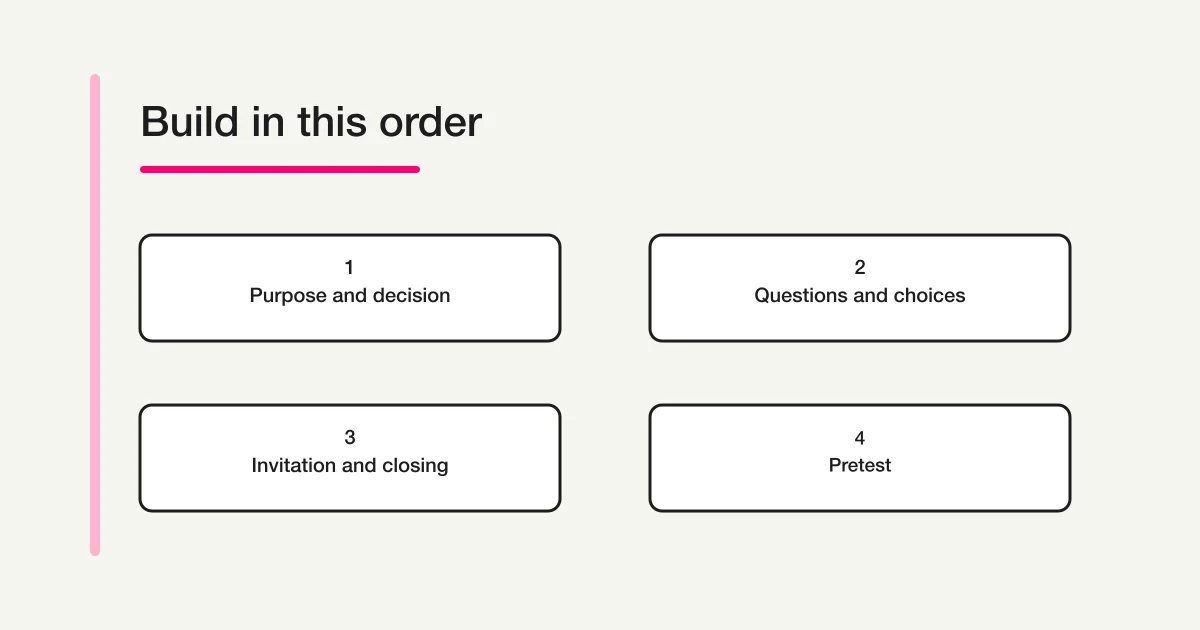
Create a survey as one journey: decision, audience, questions, choices, invitation, introduction and closing. Start by stating what you will decide after collecting answers, then remove questions that do not support it. The examples below can be adapted together instead of copying an isolated question list.
Dates, completion-time estimates and follow-up promises are placeholders to verify in your own operation. Pretest the entire route before distribution; these examples do not establish a response-rate improvement.
Start with a complete example
Here is a compact customer-satisfaction survey from invitation through closing.
Subject: Tell us about your recent experience (about 3 minutes)

Message:
Thank you for using our service.
To help us choose the next improvement, please answer a short survey
about your experience in the past 30 days. It takes about 3 minutes.
Deadline: September 11 at 6:00 p.m.

Introduction:
We will use responses to review service improvements.
Enter an email address at the end only if you would like an individual reply.

Questions:
1. Which service did you use?
2. How satisfied were you overall? (Five-point scale)
3. Which one reason had the greatest effect on your rating?
4. What should we improve? (Optional)
5. Would you like us to contact you about this response?

Closing:
Thank you. We will use the responses when selecting the next improvement.
Replace the date, effort estimate, purpose, and contact policy with facts from your operation. This example cannot guarantee a response rate. Delivery channel, audience interest, survey burden, and the relationship between requester and respondent all affect participation.
How to create a survey in seven steps
1. Define the purpose in one sentence
Write the decision, not merely the topic.
- Vague: collect customer feedback
- Specific: ask customers who used the service in the past 30 days which one improvement should enter the next development cycle
A decision-led purpose helps define the audience, recall period, comparison fields, and role of open text.
2. Define the audience and what decision each answer will support
Replace “customers” with a testable audience such as “people who used the service in the past 30 days.” Next to each proposed question, write what decision each answer will support. If nobody can explain how an answer will be used, remove the question or make it optional.
3. Ask one thing at a time
Pew Research Center and the UK Government Analysis Function emphasize clear, specific wording, questions that ask one thing at a time, and wording that does not push respondents toward a preferred answer.
| Problem | Weak example | Better example |
|---|---|---|
| Leading | How useful was our convenient new feature? | How useful, if at all, was the new feature? |
| Double-barreled | How satisfied were you with support speed and helpfulness? | Ask about speed and helpfulness separately |
| Vague period | How often have you used it recently? | How many times did you use it in the past 30 days? |
| Assumption | Which feature helped you? | Did any feature help you? Ask which one only after Yes |
Do not ask respondents to rate two outcomes with one answer. Split satisfaction and likelihood to return into separate questions. For the design of a five-point scale, use the five-point satisfaction survey guide.
4. Make answer choices exhaustive and non-overlapping
Include the major states a respondent can reasonably occupy, while making sure one response does not fit two categories.
Weak: once, 2 to 3 times, 3 or more times
Better: once, twice, 3 or more times, do not remember
Keep ordered scales in a consistent low-to-high or high-to-low direction. Add Other when a material answer may be missing, then request text only when it will be reviewed.
5. Write the invitation and introduction
An invitation normally needs the sender, audience, purpose, effort estimate, deadline, link, and a contact route. The introduction can explain whether participation is optional or required, how responses will be used, whether responses are named or anonymous, and when individual contact may occur.
Japan's Personal Information Protection Commission gives a survey as an example where a business directly obtains personal information and needs to make the purpose of use clear. A practical starting point is to let a respondent see the purpose before submitting personal information and to omit name or contact fields when the decision does not require them. This is general information, not legal advice for a particular survey or jurisdiction.
6. Write the closing and the real next step
Go beyond “Thank you” and explain what will actually happen.
- Improvement review: “We will review these responses in our September improvement meeting.”
- Individual follow-up: “If you requested contact, a team member aims to reply within three business days.”
- Aggregate use: “We will aggregate responses and use them in product planning.”
Do not promise a response date, publication of results, or a policy change that the operation cannot deliver.
7. Pretest with people like the audience
Pew Research Center describes pretesting as an essential part of questionnaire development. U.S. Census Bureau guidance uses pretesting to find problems with content, order and context, routing, and presentation. Ask two to five people similar to the audience to complete the draft. That number is a practical early check, not a validation standard.
Check whether they:
- interpreted each question as intended;
- found an answer choice that fit;
- saw the information needed before answering;
- could enter, revise, and submit on a phone;
- took about as long as the invitation claimed.
Put questions in an order respondents can follow
There is no single question order that fits every study. A practical default is to help respondents identify the relevant experience before asking them to judge it. Then ask for the reason behind the judgment and leave personally identifying fields until the end, if the operation genuinely needs them.
- Confirm the subject: identify the service, event, meeting, or concept the response concerns.
- Ask about facts or experience: ask about attendance, frequency, or recent use before opinions.
- Request the key evaluation: place satisfaction, usefulness, or clarity on the scale selected for the decision.
- Ask for the reason: use one or more defined choices before asking for prose.
- Offer optional open text: collect only the detail someone will actually review.
- Request identifying information only when needed: put name or email last and explain the follow-up it enables.
Earlier questions can change how later ones are interpreted. For example, listing a series of feature problems before an overall satisfaction question may focus respondents on shortcomings. Decide whether the overall rating belongs before or after detailed ratings, and use a pretest to see how the order changes interpretation instead of assuming one arrangement is universally neutral.
When conditional routing is present, test every route. A respondent who does not qualify for a detailed follow-up should move forward without seeing an irrelevant required field. A routed question should still name its subject and recall period clearly when read on its own. U.S. Census Bureau pretesting standards likewise treat question order and context, routing, and presentation as testable parts of the questionnaire, not merely formatting details.
Complete survey examples by use case
Customer satisfaction
Subject: Service improvement survey (about 3 minutes; reply by September 11)

Invitation:
Thank you for using our service. We are asking customers who used it in the
past 30 days to help us choose the next improvement. The survey takes about
three minutes. Please respond by 6:00 p.m. on September 11.
Survey link: https://example.com/survey

Introduction:
Answer about your experience in the past 30 days. We will use responses to
review service improvements. Enter an email address at the end only if you
would like an individual reply.

Questions:
1. Which service did you use?
   Choices: Service A / Service B / Service C / Other
2. How many times did you use it in the past 30 days?
   Choices: Once / Twice / 3 or more times / Do not remember
3. How satisfied were you overall?
   Choices: Very dissatisfied / Dissatisfied / Neither / Satisfied / Very satisfied
4. Which one factor had the greatest effect on that rating?
   Choices: Features / Ease of use / Price / Support / Other
5. What is the first thing we should improve? (Optional open text)
6. Would you like an individual reply about this response?
   Choices: No / Yes
7. If Yes, enter your email address.

Closing:
Thank you. We will review the responses at our September improvement meeting
and use them when selecting the next improvement.
Employee survey
Subject: Recurring-meeting improvement survey (reply by September 11)

Invitation:
We are reviewing how recurring meetings are run. Please think about meetings
from the past four weeks and complete this optional four-minute survey by
6:00 p.m. on September 11.

Introduction:
We will report responses in aggregate and use them to improve meetings, not
to evaluate individuals. Do not put a person's name or an identifiable client
name in the open-text field.

Questions:
1. How many recurring meetings did you attend in the past four weeks?
   Choices: None / 1 / 2 to 3 / 4 or more
2. How clear was the purpose before each meeting?
   Choices: Not at all clear / Slightly clear / Neither / Mostly clear / Very clear
3. What most needs improvement? (Select all that apply.)
   Choices: Agenda / Time allocation / Attendees / Decisions / Notes / Nothing / Other
4. What is the first change you recommend? (Optional open text)
5. Only if needed for aggregate analysis, choose your department.
   Choices: Sales / Planning / Engineering / Operations / Prefer not to answer

Closing:
Thank you. We will share the main findings and the changes we will make at the
next company meeting.
An employee survey needs an additional power and anonymity check. The employee-survey anonymity guide covers participation pressure, reminders, and reporting boundaries.
Post-event survey
Subject: Tell us about today's event (about 2 minutes)

Invitation:
Thank you for attending. Please complete a two-minute survey to help us
improve the next event's content and facilitation. The deadline is 6:00 p.m.
on September 12, the day after the event.

Introduction:
Answer about the session you attended today. We will use responses to plan
the next event and improve delivery.

Questions:
1. Of the sessions you attended, choose the one you mainly want to evaluate.
   Choices: Keynote / Session A / Session B / Networking session
2. How useful is the content likely to be in your work?
   Choices: Not useful / Slightly useful / Neither / Useful / Very useful
3. How was the session length?
   Choices: Much too short / Slightly short / About right / Slightly long / Much too long
4. Which one topic would you most like next time?
   Choices: Topic A / Topic B / Topic C / Other
5. Add a comment for the speaker or event team. (Optional open text)

Closing:
Thank you. We will use the responses when selecting the next topic and
improving the event schedule.
Product-concept research
Subject: Research on a new product concept (about 5 minutes)

Invitation:
We are asking potential customers to help us improve a product description
that is still under consideration. The survey takes about five minutes and
closes at 6:00 p.m. on September 15. It does not promise that the product will launch.

Introduction:
Read only the description shown here and answer from your current impression,
without researching the product elsewhere. We will use responses to decide
which description should move into deeper interviews.

Questions:
1. Since March 1, 2026, have you bought a product in this category?
   Choices: Bought one / Considered one but did not buy / Did not consider one
2. How clearly did you understand the description?
   Choices: Not at all / Slightly / Neither / Mostly / Completely
3. How relevant did the product feel to you?
   Choices: Not at all / Slightly / Neither / Somewhat / Very
4. Which one factor most affected your judgment?
   Choices: Problem solved / Features / Price approach / Use case / Wording / Other
5. Copy any word or phrase that was difficult to understand. (Optional)
6. Would you like an invitation to a later interview?
   Choices: No / Yes
7. If Yes, enter your contact details.

Closing:
Thank you. We will not make a launch decision from this survey alone. We will
use responses to improve the description and select participants for interviews.
Adapt the examples without breaking the survey
Do not copy only the polished sentences. Reuse the structure, then replace every operational fact. The audience, recall period, deadline, contact route, use of responses, and promise in the closing must match the real project. You can usually preserve the functional sequence: establish the relevant experience, ask for one evaluation, separate the reason from the rating, make open text optional, and request contact details only when follow-up requires them.
When changing a response scale, review the entire scale rather than editing one label. Changing a five-point scale from “Very dissatisfied” through “Very satisfied” to four points also removes the neutral midpoint. That may be intentional, but it changes the choice respondents face. When a survey will be compared with an earlier wave, record changes to the recall period, wording, options, and order. Decide before launch whether the new answers can still be treated as the same measure.
Confirm the deadline and closing with the person who owns the follow-up. “We will publish the results” requires a date, destination, and accountable reviewer. If those do not exist, narrow the statement to an action the team will certainly take, such as “We will use the responses in our improvement review.” If individual replies are offered, decide who will respond and within what realistic period. Show the contact field conditionally only to people requesting that reply when the workflow permits it.
Finally, review the survey as one continuous respondent journey. Read the email subject, invitation, introduction, questions, validation messages, and thank-you page in sequence. This catches contradictions that question-by-question review misses: an invitation may promise anonymity while a name field is required, an estimated three-minute survey may take eight minutes on a phone, or a closing may promise a report that nobody is assigned to produce.
Run the same journey through every conditional route. Confirm that each person sees the right introduction, can skip inapplicable details, and reaches a closing that accurately describes what happens to that response. Test with realistic answers, not only the shortest path, because long option labels and open text can expose problems that a clean preview does not show.
Adjust the invitation for the distribution channel
For email, put the purpose or measured effort in the subject and keep the sender, audience, deadline, and link together in the message. In workplace chat, make the audience and deadline visible in the first lines because notifications truncate longer copy; repeat essential use and contact information in the survey introduction. Beside an on-site QR code, print who the survey is for, how long it takes, and when it closes so the purpose is not hidden behind the scan. In an in-app prompt, use a short invitation with a route to the full explanation because screen space is limited.
Across channels, consistency matters more than using identical sentence lengths. The invitation and form introduction must not disagree about the audience, deadline, anonymity, or follow-up. If one link is distributed in several places, keep one approved source for the copy so a deadline is not extended in email but left unchanged on a poster. Adapt the length to the respondent's context while preserving the job of each sentence.
Create the draft in FORMLOVA
A private FORMLOVA draft can turn an approved example into fields, conditional display and a completion message. It does not validate survey methodology or automatically send the invitation. Review the operator’s privacy-policy decision and default classification/external-processing settings before collection.
When the operator publishes with a valid URL for its own privacy policy, respondent consent is required. The operator can instead explicitly confirm that a privacy-policy URL is unnecessary and publish without one. Decide from the collection purpose and data involved. Responses can be exported to CSV or Excel on every current plan.
Turn the customer example into a draft with two contact paths
This is a proposed trial, not an operation or result measured for this rewrite. Use a private test draft first.
Create a private service-improvement survey for users in the past 30 days. Ask service used, one fully labelled five-choice satisfaction item, one main reason and optional improvement text. Ask contact preference separately and show email only for Yes. Prepare matching invitation and completion copy with date/time estimates left for human verification. Give me preview URLs for the form and thank-you page before publishing. Do not publish or send.
Before proceeding, check:
- Confirm one topic per question and non-overlapping choices against the approved example.
- Try both contact branches; do not call the contact-request route anonymous.
- Read invitation, form and completion consecutively. Measure effort in a controlled respondent test, then replace placeholders. Free collects/exports; detailed analytics, custom reply and bulk invitations have separate plan conditions.
Try the survey wording as one complete route
Free supports this draft, conditional display, collection and CSV/Excel export. The button opens registration; it does not automatically clone the example or send invitations.
Register free and draft the customer survey
Register, verify your email, connect a supported AI client, and paste the proposed request above. Check the saved draft before publishing. AI-client account and usage requirements apply separately.
When a valid operator privacy-policy URL is configured, responder consent is required; publication also supports an explicit no-policy-URL decision. Choose according to the actual purpose and data, not as a shortcut around required notice. See the anonymous survey guide for the separate identity review.
Survey preflight checklist
- The purpose includes the decision to make after responses arrive.
- The audience and recall period are specific.
- Each question asks one thing.
- No wording praises, blames, or assumes an answer.
- Choices are exhaustive, non-overlapping, and at a consistent level.
- Period and scale remain consistent where results will be compared.
- Name, email, and affiliation are collected only when the next action needs them.
- Respondents can see the purpose before submitting personal information.
- The effort estimate was measured rather than guessed.
- Both desktop and phone submission paths were tested.
- The closing makes no promise the team cannot keep.
Frequently asked questions
What should a survey invitation contain?
Include the sender, intended audience, purpose, measured effort estimate, deadline, response link, and contact route. Repeat anonymity or follow-up conditions in the introduction when they materially affect a respondent's choice.
Is “Please share your feedback” enough?
It leaves the purpose, recall period, and effort unclear. A more specific version is: “To choose the next improvement, please answer a three-minute survey about your experience in the past 30 days.”
Can I use these examples without changes?
Reuse the structure, but replace the audience, purpose, deadline, contact route, privacy information, and promised next step with operational facts.
Should the survey be anonymous?
Choose based on the decision and follow-up need. Omitting a name field does not guarantee anonymity because rare attributes, open text, access logs, or a small reporting group may identify someone.
What to do next
Select one use-case example and replace operational facts across every surface. Distribute only after the intended reader can complete and interpret the whole route.
Related Guides and References
Disclosure and Verification
The author develops FORMLOVA. The survey copy in this article was written for this guide from principles checked in the official sources below; it is not a guarantee of methodological or legal suitability for every study.
- Pew Research Center: Writing Survey Questions
- UK Government Analysis Function: Questionnaire design guidance
- U.S. Census Bureau: Questionnaire Testing and Evaluation Methods
- Personal Information Protection Commission of Japan: General Guidelines
For the complete creation, distribution, aggregation, and analysis path, continue to the survey form and analysis guide.